Introduction
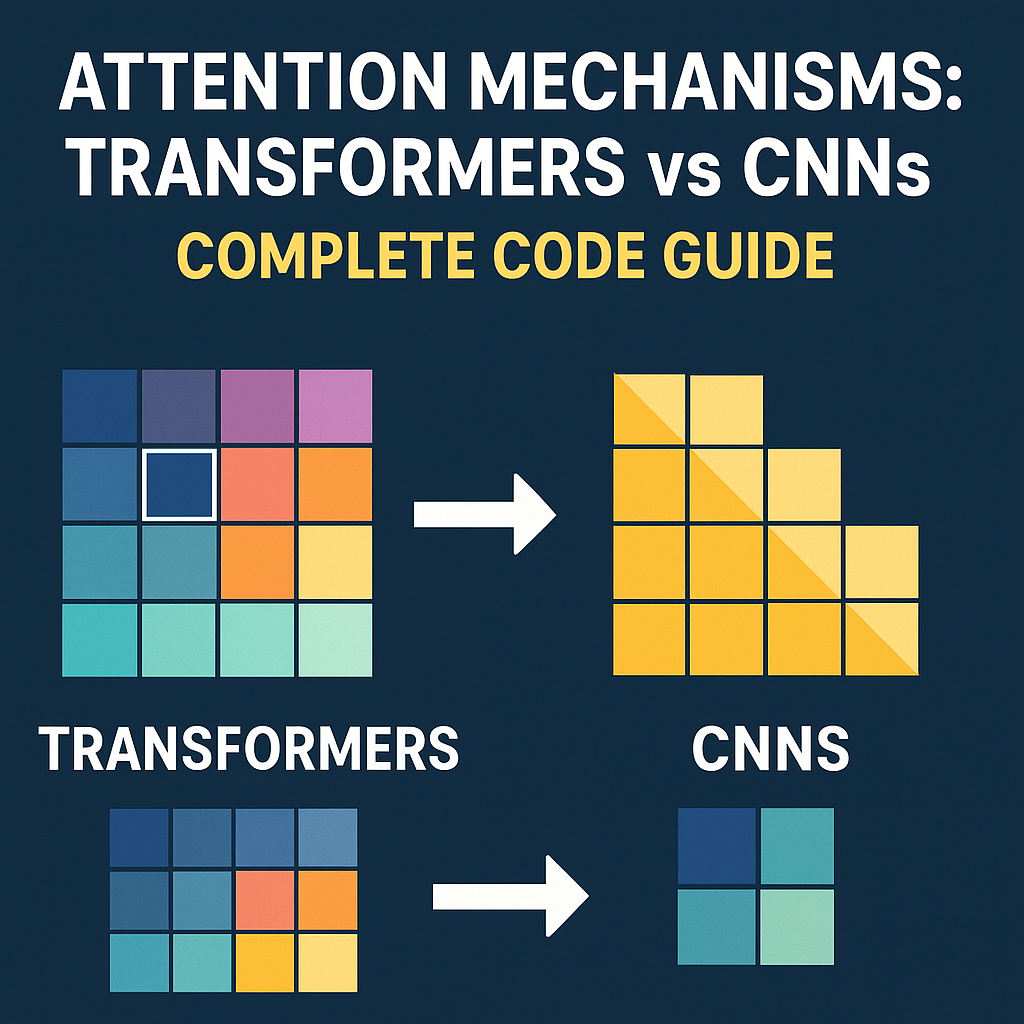
Attention mechanisms have revolutionized deep learning by allowing models to focus on relevant parts of input data. While Transformers use self-attention as their core mechanism, CNNs incorporate attention as an enhancement to their convolutional operations.
Transformer Attention
Multi-Head Self-Attention Implementation
import torch
import torch.nn as nn
import torch.nn.functional as F
import math

class MultiHeadAttention(nn.Module):
    def __init__(self, d_model, num_heads, dropout=0.1):
        super().__init__()
        assert d_model % num_heads == 0

        self.d_model = d_model
        self.num_heads = num_heads
        self.d_k = d_model // num_heads

        # Linear projections for Q, K, V
        self.w_q = nn.Linear(d_model, d_model)
        self.w_k = nn.Linear(d_model, d_model)
        self.w_v = nn.Linear(d_model, d_model)
        self.w_o = nn.Linear(d_model, d_model)

        self.dropout = nn.Dropout(dropout)

    def scaled_dot_product_attention(self, Q, K, V, mask=None):
        """
        Compute scaled dot-product attention
        Args:
            Q: Query matrix [batch_size, num_heads, seq_len, d_k]
            K: Key matrix [batch_size, num_heads, seq_len, d_k]
            V: Value matrix [batch_size, num_heads, seq_len, d_k]
            mask: Optional mask [batch_size, 1, seq_len, seq_len]
        """
        # Calculate attention scores
        scores = torch.matmul(Q, K.transpose(-2, -1)) / math.sqrt(self.d_k)

        # Apply mask if provided
        if mask is not None:
            scores = scores.masked_fill(mask == 0, -1e9)

        # Softmax normalization
        attention_weights = F.softmax(scores, dim=-1)
        attention_weights = self.dropout(attention_weights)

        # Apply attention to values
        output = torch.matmul(attention_weights, V)

        return output, attention_weights

    def forward(self, query, key, value, mask=None):
        batch_size, seq_len = query.size(0), query.size(1)

        # Linear projections and reshape for multi-head
        Q = self.w_q(query).view(batch_size, seq_len, self.num_heads, self.d_k).transpose(1, 2)
        K = self.w_k(key).view(batch_size, seq_len, self.num_heads, self.d_k).transpose(1, 2)
        V = self.w_v(value).view(batch_size, seq_len, self.num_heads, self.d_k).transpose(1, 2)

        # Apply attention
        attention_output, attention_weights = self.scaled_dot_product_attention(Q, K, V, mask)

        # Concatenate heads
        attention_output = attention_output.transpose(1, 2).contiguous().view(
            batch_size, seq_len, self.d_model
        )

        # Final linear projection
        output = self.w_o(attention_output)

        return output, attention_weights

# Complete Transformer Block
class TransformerBlock(nn.Module):
    def __init__(self, d_model, num_heads, d_ff, dropout=0.1):
        super().__init__()
        self.attention = MultiHeadAttention(d_model, num_heads, dropout)
        self.norm1 = nn.LayerNorm(d_model)
        self.norm2 = nn.LayerNorm(d_model)

        self.feed_forward = nn.Sequential(
            nn.Linear(d_model, d_ff),
            nn.ReLU(),
            nn.Dropout(dropout),
            nn.Linear(d_ff, d_model)
        )

        self.dropout = nn.Dropout(dropout)

    def forward(self, x, mask=None):
        # Self-attention with residual connection
        attn_output, attn_weights = self.attention(x, x, x, mask)
        x = self.norm1(x + self.dropout(attn_output))

        # Feed-forward with residual connection
        ff_output = self.feed_forward(x)
        x = self.norm2(x + self.dropout(ff_output))

        return x, attn_weights

# Example usage
def transformer_example():
    batch_size, seq_len, d_model = 2, 10, 512
    num_heads, d_ff = 8, 2048

    # Create input
    x = torch.randn(batch_size, seq_len, d_model)

    # Create transformer block
    transformer = TransformerBlock(d_model, num_heads, d_ff)

    # Forward pass
    output, attention_weights = transformer(x)

    print(f"Input shape: {x.shape}")
    print(f"Output shape: {output.shape}")
    print(f"Attention weights shape: {attention_weights.shape}")

    return output, attention_weights
Positional Encoding for Transformers
class PositionalEncoding(nn.Module):
    def __init__(self, d_model, max_len=5000):
        super().__init__()

        pe = torch.zeros(max_len, d_model)
        position = torch.arange(0, max_len).unsqueeze(1).float()

        div_term = torch.exp(torch.arange(0, d_model, 2).float() *
                           -(math.log(10000.0) / d_model))

        pe[:, 0::2] = torch.sin(position * div_term)
        pe[:, 1::2] = torch.cos(position * div_term)

        self.register_buffer('pe', pe.unsqueeze(0))

    def forward(self, x):
        return x + self.pe[:, :x.size(1)]
CNN Attention
Spatial Attention Mechanism
class SpatialAttention(nn.Module):
    def __init__(self, kernel_size=7):
        super().__init__()
        self.conv = nn.Conv2d(2, 1, kernel_size, padding=kernel_size//2, bias=False)
        self.sigmoid = nn.Sigmoid()

    def forward(self, x):
        # Compute spatial statistics
        avg_pool = torch.mean(x, dim=1, keepdim=True)  # [B, 1, H, W]
        max_pool, _ = torch.max(x, dim=1, keepdim=True)  # [B, 1, H, W]

        # Concatenate along channel dimension
        spatial_info = torch.cat([avg_pool, max_pool], dim=1)  # [B, 2, H, W]

        # Generate attention map
        attention_map = self.conv(spatial_info)  # [B, 1, H, W]
        attention_map = self.sigmoid(attention_map)

        # Apply attention
        return x * attention_map

class ChannelAttention(nn.Module):
    def __init__(self, in_channels, reduction_ratio=16):
        super().__init__()
        self.avg_pool = nn.AdaptiveAvgPool2d(1)
        self.max_pool = nn.AdaptiveMaxPool2d(1)

        self.fc = nn.Sequential(
            nn.Linear(in_channels, in_channels // reduction_ratio, bias=False),
            nn.ReLU(),
            nn.Linear(in_channels // reduction_ratio, in_channels, bias=False)
        )

        self.sigmoid = nn.Sigmoid()

    def forward(self, x):
        b, c, h, w = x.size()

        # Global average pooling and max pooling
        avg_pool = self.avg_pool(x).view(b, c)
        max_pool = self.max_pool(x).view(b, c)

        # Channel attention
        avg_out = self.fc(avg_pool)
        max_out = self.fc(max_pool)

        # Combine and apply sigmoid
        channel_attention = self.sigmoid(avg_out + max_out).view(b, c, 1, 1)

        return x * channel_attention

# CBAM (Convolutional Block Attention Module)
class CBAM(nn.Module):
    def __init__(self, in_channels, reduction_ratio=16, kernel_size=7):
        super().__init__()
        self.channel_attention = ChannelAttention(in_channels, reduction_ratio)
        self.spatial_attention = SpatialAttention(kernel_size)

    def forward(self, x):
        # Apply channel attention first
        x = self.channel_attention(x)
        # Then apply spatial attention
        x = self.spatial_attention(x)
        return x

# Self-Attention for CNNs
class SelfAttention2D(nn.Module):
    def __init__(self, in_channels):
        super().__init__()
        self.in_channels = in_channels

        self.query_conv = nn.Conv2d(in_channels, in_channels // 8, 1)
        self.key_conv = nn.Conv2d(in_channels, in_channels // 8, 1)
        self.value_conv = nn.Conv2d(in_channels, in_channels, 1)

        self.gamma = nn.Parameter(torch.zeros(1))
        self.softmax = nn.Softmax(dim=-1)

    def forward(self, x):
        batch_size, channels, height, width = x.size()

        # Generate Q, K, V
        proj_query = self.query_conv(x).view(batch_size, -1, width * height).permute(0, 2, 1)
        proj_key = self.key_conv(x).view(batch_size, -1, width * height)
        proj_value = self.value_conv(x).view(batch_size, -1, width * height)

        # Compute attention
        energy = torch.bmm(proj_query, proj_key)
        attention = self.softmax(energy)

        # Apply attention to values
        out = torch.bmm(proj_value, attention.permute(0, 2, 1))
        out = out.view(batch_size, channels, height, width)

        # Residual connection with learnable weight
        out = self.gamma * out + x

        return out

# CNN with Attention
class AttentionCNN(nn.Module):
    def __init__(self, num_classes=10):
        super().__init__()

        self.conv1 = nn.Conv2d(3, 64, 3, padding=1)
        self.cbam1 = CBAM(64)

        self.conv2 = nn.Conv2d(64, 128, 3, padding=1)
        self.cbam2 = CBAM(128)

        self.conv3 = nn.Conv2d(128, 256, 3, padding=1)
        self.self_attention = SelfAttention2D(256)

        self.pool = nn.AdaptiveAvgPool2d(1)
        self.classifier = nn.Linear(256, num_classes)

    def forward(self, x):
        # First block
        x = F.relu(self.conv1(x))
        x = self.cbam1(x)
        x = F.max_pool2d(x, 2)

        # Second block
        x = F.relu(self.conv2(x))
        x = self.cbam2(x)
        x = F.max_pool2d(x, 2)

        # Third block with self-attention
        x = F.relu(self.conv3(x))
        x = self.self_attention(x)
        x = F.max_pool2d(x, 2)

        # Classification
        x = self.pool(x)
        x = x.view(x.size(0), -1)
        x = self.classifier(x)

        return x

# Example usage
def cnn_attention_example():
    batch_size = 4
    x = torch.randn(batch_size, 3, 224, 224)

    model = AttentionCNN(num_classes=1000)
    output = model(x)

    print(f"Input shape: {x.shape}")
    print(f"Output shape: {output.shape}")

    return output
Key Differences
1. Computational Complexity
def attention_complexity_comparison():
    """
    Compare computational complexity of different attention mechanisms
    """

    # Transformer Self-Attention: O(n²d) where n=sequence length, d=dimension
    def transformer_complexity(seq_len, d_model):
        return seq_len * seq_len * d_model

    # CNN Spatial Attention: O(HW) where H=height, W=width
    def spatial_attention_complexity(height, width):
        return height * width

    # CNN Channel Attention: O(C) where C=channels
    def channel_attention_complexity(channels):
        return channels

    # Example calculations
    seq_len, d_model = 512, 512
    height, width, channels = 224, 224, 256

    transformer_ops = transformer_complexity(seq_len, d_model)
    spatial_ops = spatial_attention_complexity(height, width)
    channel_ops = channel_attention_complexity(channels)

    print(f"Transformer attention operations: {transformer_ops:,}")
    print(f"CNN spatial attention operations: {spatial_ops:,}")
    print(f"CNN channel attention operations: {channel_ops:,}")

    return {
        'transformer': transformer_ops,
        'spatial': spatial_ops,
        'channel': channel_ops
    }
2. Information Flow Patterns
class AttentionAnalysis:
    @staticmethod
    def analyze_transformer_attention(attention_weights):
        """
        Analyze attention patterns in Transformers
        Args:
            attention_weights: [batch_size, num_heads, seq_len, seq_len]
        """
        batch_size, num_heads, seq_len, _ = attention_weights.shape

        # Average attention across heads
        avg_attention = attention_weights.mean(dim=1)  # [batch_size, seq_len, seq_len]

        # Compute attention statistics
        max_attention = avg_attention.max(dim=-1)[0]  # Max attention per position
        attention_entropy = -torch.sum(avg_attention * torch.log(avg_attention + 1e-8), dim=-1)

        return {
            'max_attention': max_attention,
            'attention_entropy': attention_entropy,
            'global_connectivity': True,  # All positions can attend to all others
            'pattern': 'sequence-to-sequence'
        }

    @staticmethod
    def analyze_cnn_attention(feature_map, attention_map):
        """
        Analyze attention patterns in CNNs
        Args:
            feature_map: [batch_size, channels, height, width]
            attention_map: [batch_size, 1, height, width] or [batch_size, channels, 1, 1]
        """
        if attention_map.dim() == 4 and attention_map.size(2) == 1:
            # Channel attention
            attention_type = 'channel'
            local_connectivity = False
        else:
            # Spatial attention
            attention_type = 'spatial'
            local_connectivity = True

        return {
            'attention_type': attention_type,
            'local_connectivity': local_connectivity,
            'pattern': 'spatial-hierarchy' if attention_type == 'spatial' else 'channel-selection'
        }
Performance Comparison
import time
import torch.nn.functional as F

class PerformanceBenchmark:
    def __init__(self):
        self.device = torch.device('cuda' if torch.cuda.is_available() else 'cpu')

    def benchmark_transformer_attention(self, batch_size=32, seq_len=512, d_model=512, num_heads=8):
        """Benchmark Transformer attention"""
        model = MultiHeadAttention(d_model, num_heads).to(self.device)
        x = torch.randn(batch_size, seq_len, d_model).to(self.device)

        # Warmup
        for _ in range(10):
            _ = model(x, x, x)

        # Benchmark
        torch.cuda.synchronize() if torch.cuda.is_available() else None
        start_time = time.time()

        for _ in range(100):
            output, _ = model(x, x, x)

        torch.cuda.synchronize() if torch.cuda.is_available() else None
        end_time = time.time()

        return (end_time - start_time) / 100

    def benchmark_cnn_attention(self, batch_size=32, channels=256, height=56, width=56):
        """Benchmark CNN attention"""
        model = CBAM(channels).to(self.device)
        x = torch.randn(batch_size, channels, height, width).to(self.device)

        # Warmup
        for _ in range(10):
            _ = model(x)

        # Benchmark
        torch.cuda.synchronize() if torch.cuda.is_available() else None
        start_time = time.time()

        for _ in range(100):
            output = model(x)

        torch.cuda.synchronize() if torch.cuda.is_available() else None
        end_time = time.time()

        return (end_time - start_time) / 100

    def run_comparison(self):
        """Run performance comparison"""
        transformer_time = self.benchmark_transformer_attention()
        cnn_time = self.benchmark_cnn_attention()

        print(f"Transformer attention time: {transformer_time:.4f}s")
        print(f"CNN attention time: {cnn_time:.4f}s")
        print(f"Speedup: {transformer_time/cnn_time:.2f}x")

        return {
            'transformer_time': transformer_time,
            'cnn_time': cnn_time,
            'speedup': transformer_time/cnn_time
        }

# Memory usage comparison
def memory_comparison():
    """Compare memory usage of different attention mechanisms"""

    def get_memory_usage():
        if torch.cuda.is_available():
            return torch.cuda.memory_allocated() / 1024**2  # MB
        return 0

    # Clear memory
    torch.cuda.empty_cache() if torch.cuda.is_available() else None

    # Transformer attention
    transformer_model = MultiHeadAttention(512, 8)
    x = torch.randn(32, 512, 512)

    if torch.cuda.is_available():
        transformer_model = transformer_model.cuda()
        x = x.cuda()

    transformer_memory = get_memory_usage()
    _, _ = transformer_model(x, x, x)
    transformer_memory = get_memory_usage() - transformer_memory

    # Clear memory
    del transformer_model, x
    torch.cuda.empty_cache() if torch.cuda.is_available() else None

    # CNN attention
    cnn_model = CBAM(256)
    x = torch.randn(32, 256, 56, 56)

    if torch.cuda.is_available():
        cnn_model = cnn_model.cuda()
        x = x.cuda()

    cnn_memory = get_memory_usage()
    _ = cnn_model(x)
    cnn_memory = get_memory_usage() - cnn_memory

    print(f"Transformer attention memory: {transformer_memory:.2f} MB")
    print(f"CNN attention memory: {cnn_memory:.2f} MB")

    return {
        'transformer_memory': transformer_memory,
        'cnn_memory': cnn_memory
    }
When to Use Each
Decision Framework
class AttentionSelector:
    @staticmethod
    def recommend_attention_type(data_type, sequence_length=None, spatial_dims=None,
                                computational_budget='medium', task_type='classification'):
        """
        Recommend attention mechanism based on requirements

        Args:
            data_type: 'sequential', 'spatial', 'mixed'
            sequence_length: Length of sequences (for sequential data)
            spatial_dims: (height, width) for spatial data
            computational_budget: 'low', 'medium', 'high'
            task_type: 'classification', 'generation', 'detection'
        """

        recommendations = []

        # Sequential data
        if data_type == 'sequential':
            if sequence_length and sequence_length > 1000 and computational_budget == 'low':
                recommendations.append({
                    'type': 'Local Attention',
                    'reason': 'Long sequences with limited compute',
                    'implementation': 'sliding_window_attention'
                })
            else:
                recommendations.append({
                    'type': 'Transformer Self-Attention',
                    'reason': 'Global context modeling for sequences',
                    'implementation': 'MultiHeadAttention'
                })

        # Spatial data
        elif data_type == 'spatial':
            if spatial_dims and spatial_dims[0] * spatial_dims[1] > 224 * 224:
                recommendations.append({
                    'type': 'CNN Spatial + Channel Attention',
                    'reason': 'High-resolution spatial data',
                    'implementation': 'CBAM'
                })
            else:
                recommendations.append({
                    'type': 'CNN Self-Attention',
                    'reason': 'Moderate resolution with global context',
                    'implementation': 'SelfAttention2D'
                })

        # Mixed data
        elif data_type == 'mixed':
            recommendations.append({
                'type': 'Hybrid Attention',
                'reason': 'Combined sequential and spatial processing',
                'implementation': 'transformer_cnn_hybrid'
            })

        return recommendations

    @staticmethod
    def create_hybrid_model(input_shape, num_classes):
        """Create a hybrid model combining both attention types"""

        class HybridAttentionModel(nn.Module):
            def __init__(self, input_shape, num_classes):
                super().__init__()

                # CNN backbone with attention
                self.cnn_backbone = nn.Sequential(
                    nn.Conv2d(input_shape[0], 64, 3, padding=1),
                    nn.ReLU(),
                    CBAM(64),
                    nn.MaxPool2d(2),

                    nn.Conv2d(64, 128, 3, padding=1),
                    nn.ReLU(),
                    CBAM(128),
                    nn.MaxPool2d(2),

                    nn.Conv2d(128, 256, 3, padding=1),
                    nn.ReLU(),
                    SelfAttention2D(256)
                )

                # Flatten and prepare for transformer
                self.flatten = nn.AdaptiveAvgPool2d(8)  # 8x8 spatial grid
                self.embed_dim = 256

                # Transformer layers
                self.transformer = nn.Sequential(
                    *[TransformerBlock(self.embed_dim, 8, 1024) for _ in range(3)]
                )

                # Classification head
                self.classifier = nn.Linear(self.embed_dim, num_classes)

            def forward(self, x):
                # CNN processing
                x = self.cnn_backbone(x)

                # Reshape for transformer
                batch_size = x.size(0)
                x = self.flatten(x)  # [B, 256, 8, 8]
                x = x.flatten(2).transpose(1, 2)  # [B, 64, 256]

                # Transformer processing
                for transformer_block in self.transformer:
                    x, _ = transformer_block(x)

                # Global average pooling and classification
                x = x.mean(dim=1)  # [B, 256]
                x = self.classifier(x)

                return x

        return HybridAttentionModel(input_shape, num_classes)

# Usage examples
def usage_examples():
    """Demonstrate when to use each attention type"""

    selector = AttentionSelector()

    # Example 1: NLP task
    nlp_rec = selector.recommend_attention_type(
        data_type='sequential',
        sequence_length=512,
        computational_budget='high',
        task_type='generation'
    )

    # Example 2: Computer Vision task
    cv_rec = selector.recommend_attention_type(
        data_type='spatial',
        spatial_dims=(224, 224),
        computational_budget='medium',
        task_type='classification'
    )

    # Example 3: Video analysis
    video_rec = selector.recommend_attention_type(
        data_type='mixed',
        sequence_length=30,
        spatial_dims=(112, 112),
        computational_budget='high',
        task_type='detection'
    )

    print("NLP Recommendation:", nlp_rec)
    print("Computer Vision Recommendation:", cv_rec)
    print("Video Analysis Recommendation:", video_rec)

    return nlp_rec, cv_rec, video_rec
Summary
| Aspect | Transformer Attention | CNN Attention |
|---|---|---|
| Scope | Global, all-to-all | Local, spatial/channel-wise |
| Complexity | O(n²) | O(HW) or O(C) |
| Best For | Sequential data, language | Spatial data, images |
| Memory | High | Moderate |
| Parallelization | Limited by sequence length | Highly parallelizable |
| Interpretability | Attention weights show relationships | Spatial/channel importance maps |
Choose Transformer attention for tasks requiring global context modeling, and CNN attention for spatially-structured data where local relationships dominate. Consider hybrid approaches for complex multi-modal tasks.