
Introduction
MobileNet is a family of efficient neural network architectures designed specifically for mobile and embedded devices. The key innovation is the use of depthwise separable convolutions which dramatically reduce the number of parameters and computational cost while maintaining reasonable accuracy.
Prerequisites and Setup
Before diving into MobileNet implementation, ensure you have the following prerequisites:
Software Requirements:
- Python 3.8+
- PyTorch 1.12+
- torchvision 0.13+
- CUDA (optional, for GPU acceleration)
Hardware Recommendations:
- 8GB+ RAM for training
- NVIDIA GPU with 4GB+ VRAM (recommended)
- SSD storage for faster data loading
Installation
# Core dependencies
pip install torch torchvision torchaudio
pip install numpy matplotlib seaborn
pip install pillow opencv-python

# Optional dependencies for advanced features
pip install tensorboard  # For training visualization
pip install ptflops      # For FLOPs calculation
pip install onnx onnxruntime  # For model export
pip install coremltools      # For iOS deployment
pip install tensorflow-lite  # For Android deployment

# Development tools
pip install jupyter notebook
pip install black isort      # Code formatting
Quick Start Example
Here’s a minimal example to get you started with MobileNet:
import torch
import torchvision.models as models
from torchvision import transforms
import numpy as np

# Load pre-trained model
model = models.mobilenet_v2(pretrained=True)
model.eval()

print(f"✅ Model loaded successfully!")
print(f"📊 Total parameters: {sum(p.numel() for p in model.parameters()):,}")
print(f"💾 Model size: {sum(p.numel() * p.element_size() for p in model.parameters()) / 1024**2:.1f} MB")

# Test with random input
dummy_input = torch.randn(1, 3, 224, 224)
with torch.no_grad():
    output = model(dummy_input)

print(f"🎯 Output shape: {output.shape}")
print(f"🔥 Top prediction: Class {torch.argmax(output).item()}")
✅ Model loaded successfully!
📊 Total parameters: 3,504,872
💾 Model size: 13.4 MB
🎯 Output shape: torch.Size([1, 1000])
🔥 Top prediction: Class 644Key Features
- Efficient: 50x fewer parameters than AlexNet
- Fast: Optimized for mobile inference
- Flexible: Width and resolution multipliers for different use cases
- Accurate: Competitive performance on ImageNet
MobileNet achieves its efficiency through depthwise separable convolutions, which split standard convolutions into two operations: depthwise and pointwise convolutions.
Architecture Comparison Table
| Architecture | Parameters (M) | FLOPs (M) | Top-1 Accuracy (%) | Model Size (MB) | Target Device |
|---|---|---|---|---|---|
| AlexNet | 61.0 | 714 | 56.5 | 233 | Desktop |
| VGG-16 | 138.0 | 15500 | 71.5 | 528 | Desktop |
| ResNet-50 | 25.6 | 4100 | 76.1 | 98 | Server |
| MobileNet-V1 | 4.2 | 569 | 70.6 | 16 | Mobile |
| MobileNet-V2 | 3.4 | 300 | 72.0 | 14 | Mobile |
| EfficientNet-B0 | 5.3 | 390 | 77.3 | 21 | Mobile |
Note: Accuracy values are for ImageNet classification. FLOPs calculated for 224×224 input images.
MobileNet Architecture
The MobileNet architecture consists of:
- Standard 3×3 convolution (first layer)
- 13 depthwise separable convolution blocks
- Average pooling and fully connected layer
Architecture Overview
import torch
import torch.nn as nn
import torch.nn.functional as F

class MobileNet(nn.Module):
    def __init__(self, num_classes=1000, width_mult=1.0):
        super(MobileNet, self).__init__()

        # First standard convolution
        self.conv1 = nn.Conv2d(3, int(32 * width_mult), 3, stride=2, padding=1, bias=False)
        self.bn1 = nn.BatchNorm2d(int(32 * width_mult))

        # Depthwise separable convolution blocks
        self.layers = nn.ModuleList([
            self._make_layer(int(32 * width_mult), int(64 * width_mult), 1),
            self._make_layer(int(64 * width_mult), int(128 * width_mult), 2),
            self._make_layer(int(128 * width_mult), int(128 * width_mult), 1),
            self._make_layer(int(128 * width_mult), int(256 * width_mult), 2),
            self._make_layer(int(256 * width_mult), int(256 * width_mult), 1),
            self._make_layer(int(256 * width_mult), int(512 * width_mult), 2),
            # 5 layers with stride 1
            *[self._make_layer(int(512 * width_mult), int(512 * width_mult), 1) for _ in range(5)],
            self._make_layer(int(512 * width_mult), int(1024 * width_mult), 2),
            self._make_layer(int(1024 * width_mult), int(1024 * width_mult), 1),
        ])

        # Global average pooling and classifier
        self.avgpool = nn.AdaptiveAvgPool2d(1)
        self.classifier = nn.Linear(int(1024 * width_mult), num_classes)

    def _make_layer(self, in_channels, out_channels, stride):
        return DepthwiseSeparableConv(in_channels, out_channels, stride)

    def forward(self, x):
        x = F.relu6(self.bn1(self.conv1(x)))

        for layer in self.layers:
            x = layer(x)

        x = self.avgpool(x)
        x = x.view(x.size(0), -1)
        x = self.classifier(x)

        return x
Depthwise Separable Convolutions
The core innovation of MobileNet is the depthwise separable convolution, which splits a standard convolution into two operations:
Depthwise Convolution
Applies a single filter per input channel (spatial filtering):
class DepthwiseConv(nn.Module):
    def __init__(self, in_channels, kernel_size=3, stride=1, padding=1):
        super(DepthwiseConv, self).__init__()
        self.depthwise = nn.Conv2d(
            in_channels, in_channels,
            kernel_size=kernel_size,
            stride=stride,
            padding=padding,
            groups=in_channels,  # Key: groups = in_channels
            bias=False
        )
        self.bn = nn.BatchNorm2d(in_channels)

    def forward(self, x):
        return F.relu6(self.bn(self.depthwise(x)))
Pointwise Convolution
Applies 1×1 convolution to combine features (channel mixing):
class PointwiseConv(nn.Module):
    def __init__(self, in_channels, out_channels):
        super(PointwiseConv, self).__init__()
        self.pointwise = nn.Conv2d(in_channels, out_channels, 1, bias=False)
        self.bn = nn.BatchNorm2d(out_channels)

    def forward(self, x):
        return F.relu6(self.bn(self.pointwise(x)))
Complete Depthwise Separable Block
class DepthwiseSeparableConv(nn.Module):
    def __init__(self, in_channels, out_channels, stride=1):
        super(DepthwiseSeparableConv, self).__init__()

        self.depthwise = DepthwiseConv(in_channels, stride=stride)
        self.pointwise = PointwiseConv(in_channels, out_channels)

    def forward(self, x):
        x = self.depthwise(x)
        x = self.pointwise(x)
        return x
Computational Efficiency
Standard Convolution:
- Parameters:
Dk × Dk × M × N - Computation:
Dk × Dk × M × N × Df × Df
Depthwise Separable Convolution:
- Parameters:
Dk × Dk × M + M × N
- Computation:
Dk × Dk × M × Df × Df + M × N × Df × Df
Reduction Factor: 1/N + 1/Dk² (typically 8-9x reduction)
Efficiency Visualization
Let’s visualize the efficiency gains of depthwise separable convolutions:
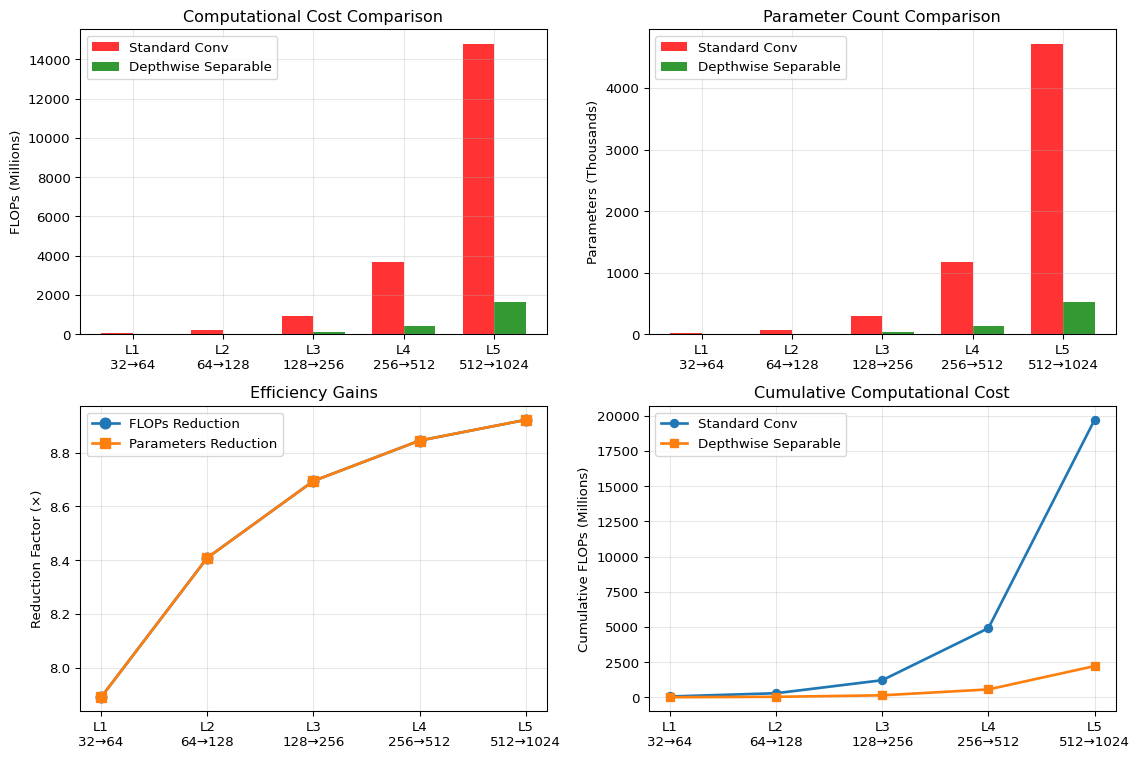
📊 **Efficiency Summary:**
   • Total FLOPs - Standard: 19710.7M
   • Total FLOPs - Depthwise: 2218.1M
   • **Overall Reduction: 8.9×**
Implementation from Scratch
Here’s a complete implementation with detailed explanations:
import torch
import torch.nn as nn
import torch.nn.functional as F
from typing import Optional

class MobileNetV1(nn.Module):
    """
    MobileNetV1 implementation with configurable width and resolution multipliers.

    Args:
        num_classes: Number of output classes
        width_mult: Width multiplier for channels (0.25, 0.5, 0.75, 1.0)
        resolution_mult: Resolution multiplier for input size
        dropout_rate: Dropout rate before classifier
    """

    def __init__(self,
                 num_classes: int = 1000,
                 width_mult: float = 1.0,
                 dropout_rate: float = 0.2):
        super(MobileNetV1, self).__init__()

        self.width_mult = width_mult

        # Helper function to make channels divisible by 8
        def _make_divisible(v, divisor=8):
            new_v = max(divisor, int(v + divisor / 2) // divisor * divisor)
            if new_v < 0.9 * v:
                new_v += divisor
            return new_v

        # Define channel configurations
        input_channel = _make_divisible(32 * width_mult)

        # First standard convolution
        self.conv1 = nn.Sequential(
            nn.Conv2d(3, input_channel, 3, 2, 1, bias=False),
            nn.BatchNorm2d(input_channel),
            nn.ReLU6(inplace=True)
        )

        # Configuration: [output_channels, stride]
        configs = [
            [64, 1],
            [128, 2], [128, 1],
            [256, 2], [256, 1],
            [512, 2], [512, 1], [512, 1], [512, 1], [512, 1], [512, 1],
            [1024, 2], [1024, 1]
        ]

        # Build depthwise separable layers
        layers = []
        for output_channel, stride in configs:
            output_channel = _make_divisible(output_channel * width_mult)
            layers.append(
                DepthwiseSeparableConv(input_channel, output_channel, stride)
            )
            input_channel = output_channel

        self.features = nn.Sequential(*layers)

        # Classifier
        self.avgpool = nn.AdaptiveAvgPool2d((1, 1))
        self.dropout = nn.Dropout(dropout_rate)
        self.classifier = nn.Linear(input_channel, num_classes)

        # Initialize weights
        self._initialize_weights()

    def _initialize_weights(self):
        """Initialize weights using He initialization for ReLU networks."""
        for m in self.modules():
            if isinstance(m, nn.Conv2d):
                nn.init.kaiming_normal_(m.weight, mode='fan_out', nonlinearity='relu')
                if m.bias is not None:
                    nn.init.zeros_(m.bias)
            elif isinstance(m, nn.BatchNorm2d):
                nn.init.ones_(m.weight)
                nn.init.zeros_(m.bias)
            elif isinstance(m, nn.Linear):
                nn.init.normal_(m.weight, 0, 0.01)
                nn.init.zeros_(m.bias)

    def forward(self, x):
        x = self.conv1(x)
        x = self.features(x)
        x = self.avgpool(x)
        x = torch.flatten(x, 1)
        x = self.dropout(x)
        x = self.classifier(x)
        return x

# Optimized Depthwise Separable Convolution with better efficiency
class DepthwiseSeparableConv(nn.Module):
    def __init__(self, in_channels, out_channels, stride=1):
        super(DepthwiseSeparableConv, self).__init__()

        self.conv = nn.Sequential(
            # Depthwise convolution
            nn.Conv2d(in_channels, in_channels, 3, stride, 1,
                     groups=in_channels, bias=False),
            nn.BatchNorm2d(in_channels),
            nn.ReLU6(inplace=True),

            # Pointwise convolution
            nn.Conv2d(in_channels, out_channels, 1, 1, 0, bias=False),
            nn.BatchNorm2d(out_channels),
            nn.ReLU6(inplace=True),
        )

    def forward(self, x):
        return self.conv(x)

# Model factory function
def mobilenet_v1(num_classes=1000, width_mult=1.0, pretrained=False):
    """
    Create MobileNetV1 model.

    Args:
        num_classes: Number of classes for classification
        width_mult: Width multiplier (0.25, 0.5, 0.75, 1.0)
        pretrained: Load pretrained weights (if available)
    """
    model = MobileNetV1(num_classes=num_classes, width_mult=width_mult)

    if pretrained:
        # In practice, you would load pretrained weights here
        print(f"Loading pretrained MobileNetV1 with width_mult={width_mult}")

    return model
Using Pre-trained MobileNet
With PyTorch (torchvision)
import torch
import torchvision.models as models
from torchvision import transforms
from PIL import Image

# Load pre-trained MobileNetV2
model = models.mobilenet_v2(pretrained=True)
model.eval()

# Preprocessing pipeline
preprocess = transforms.Compose([
    transforms.Resize(256),
    transforms.CenterCrop(224),
    transforms.ToTensor(),
    transforms.Normalize(mean=[0.485, 0.456, 0.406],
                        std=[0.229, 0.224, 0.225]),
])

# Inference function
def predict_image(image_path, model, preprocess, top_k=5):
    """Predict top-k classes for an image."""

    # Load and preprocess image
    image = Image.open(image_path).convert('RGB')
    input_tensor = preprocess(image)
    input_batch = input_tensor.unsqueeze(0)  # Add batch dimension

    # Predict
    with torch.no_grad():
        output = model(input_batch)
        probabilities = torch.nn.functional.softmax(output[0], dim=0)

    # Get top-k predictions
    top_prob, top_indices = torch.topk(probabilities, top_k)

    return [(idx.item(), prob.item()) for idx, prob in zip(top_indices, top_prob)]

# Example usage
# predictions = predict_image('cat.jpg', model, preprocess)
# print(predictions)
Fine-tuning Pre-trained MobileNet
import torch.optim as optim
import torch.nn as nn

def create_mobilenet_classifier(num_classes, pretrained=True):
    """Create MobileNet for custom classification task."""

    # Load pre-trained model
    model = models.mobilenet_v2(pretrained=pretrained)

    # Modify classifier for custom number of classes
    model.classifier = nn.Sequential(
        nn.Dropout(0.2),
        nn.Linear(model.last_channel, num_classes),
    )

    return model

# Training setup for fine-tuning
def setup_training(model, num_classes, learning_rate=0.001):
    """Setup optimizer and loss function for fine-tuning."""

    # Freeze feature extraction layers (optional)
    for param in model.features.parameters():
        param.requires_grad = False

    # Only train classifier
    optimizer = optim.Adam(model.classifier.parameters(), lr=learning_rate)
    criterion = nn.CrossEntropyLoss()

    return optimizer, criterion

# Training loop
def train_epoch(model, dataloader, optimizer, criterion, device):
    """Train model for one epoch."""
    model.train()
    running_loss = 0.0
    correct = 0
    total = 0

    for inputs, labels in dataloader:
        inputs, labels = inputs.to(device), labels.to(device)

        optimizer.zero_grad()
        outputs = model(inputs)
        loss = criterion(outputs, labels)
        loss.backward()
        optimizer.step()

        running_loss += loss.item()
        _, predicted = torch.max(outputs.data, 1)
        total += labels.size(0)
        correct += (predicted == labels).sum().item()

    return running_loss / len(dataloader), 100 * correct / total
Training MobileNet
Complete Training Pipeline
import torch
import torch.nn as nn
import torch.optim as optim
from torch.utils.data import DataLoader
from torchvision import datasets, transforms
import time

class MobileNetTrainer:
    def __init__(self, model, device='cuda'):
        self.model = model.to(device)
        self.device = device
        self.history = {'train_loss': [], 'train_acc': [], 'val_loss': [], 'val_acc': []}

    def train(self, train_loader, val_loader, epochs=10, lr=0.001):
        """Complete training pipeline."""

        # Setup optimizer and scheduler
        optimizer = optim.RMSprop(self.model.parameters(), lr=lr, weight_decay=1e-4)
        scheduler = optim.lr_scheduler.StepLR(optimizer, step_size=7, gamma=0.1)
        criterion = nn.CrossEntropyLoss()

        best_acc = 0.0

        for epoch in range(epochs):
            print(f'Epoch {epoch+1}/{epochs}')
            print('-' * 10)

            # Training phase
            train_loss, train_acc = self._train_epoch(train_loader, optimizer, criterion)

            # Validation phase
            val_loss, val_acc = self._validate_epoch(val_loader, criterion)

            # Update scheduler
            scheduler.step()

            # Save best model
            if val_acc > best_acc:
                best_acc = val_acc
                torch.save(self.model.state_dict(), 'best_mobilenet.pth')

            # Update history
            self.history['train_loss'].append(train_loss)
            self.history['train_acc'].append(train_acc)
            self.history['val_loss'].append(val_loss)
            self.history['val_acc'].append(val_acc)

            print(f'Train Loss: {train_loss:.4f}, Train Acc: {train_acc:.2f}%')
            print(f'Val Loss: {val_loss:.4f}, Val Acc: {val_acc:.2f}%')
            print()

    def _train_epoch(self, dataloader, optimizer, criterion):
        """Train for one epoch."""
        self.model.train()
        running_loss = 0.0
        correct = 0
        total = 0

        for inputs, labels in dataloader:
            inputs, labels = inputs.to(self.device), labels.to(self.device)

            optimizer.zero_grad()
            outputs = self.model(inputs)
            loss = criterion(outputs, labels)
            loss.backward()
            optimizer.step()

            running_loss += loss.item()
            _, predicted = torch.max(outputs, 1)
            total += labels.size(0)
            correct += (predicted == labels).sum().item()

        return running_loss / len(dataloader), 100 * correct / total

    def _validate_epoch(self, dataloader, criterion):
        """Validate for one epoch."""
        self.model.eval()
        running_loss = 0.0
        correct = 0
        total = 0

        with torch.no_grad():
            for inputs, labels in dataloader:
                inputs, labels = inputs.to(self.device), labels.to(self.device)

                outputs = self.model(inputs)
                loss = criterion(outputs, labels)

                running_loss += loss.item()
                _, predicted = torch.max(outputs, 1)
                total += labels.size(0)
                correct += (predicted == labels).sum().item()

        return running_loss / len(dataloader), 100 * correct / total
Data Loading and Augmentation
# Data loading and augmentation
def get_dataloaders(data_dir, batch_size=32, num_workers=4):
    """Create training and validation dataloaders."""

    # Data augmentation for training
    train_transforms = transforms.Compose([
        transforms.RandomResizedCrop(224),
        transforms.RandomHorizontalFlip(),
        transforms.ColorJitter(brightness=0.2, contrast=0.2, saturation=0.2, hue=0.1),
        transforms.ToTensor(),
        transforms.Normalize([0.485, 0.456, 0.406], [0.229, 0.224, 0.225])
    ])

    # Validation transforms
    val_transforms = transforms.Compose([
        transforms.Resize(256),
        transforms.CenterCrop(224),
        transforms.ToTensor(),
        transforms.Normalize([0.485, 0.456, 0.406], [0.229, 0.224, 0.225])
    ])

    # Create datasets
    train_dataset = datasets.ImageFolder(f'{data_dir}/train', train_transforms)
    val_dataset = datasets.ImageFolder(f'{data_dir}/val', val_transforms)

    # Create dataloaders
    train_loader = DataLoader(train_dataset, batch_size=batch_size,
                             shuffle=True, num_workers=num_workers)
    val_loader = DataLoader(val_dataset, batch_size=batch_size,
                           shuffle=False, num_workers=num_workers)

    return train_loader, val_loader, len(train_dataset.classes)

# Example usage
if __name__ == "__main__":
    # Setup
    device = torch.device('cuda' if torch.cuda.is_available() else 'cpu')

    # Load data
    # train_loader, val_loader, num_classes = get_dataloaders('path/to/data')

    # Create model
    # model = mobilenet_v1(num_classes=num_classes, width_mult=1.0)

    # Train
    # trainer = MobileNetTrainer(model, device)
    # trainer.train(train_loader, val_loader, epochs=20)
    pass
MobileNet Variants
MobileNetV2 Implementation
class InvertedResidual(nn.Module):
    """Inverted residual block for MobileNetV2."""

    def __init__(self, in_channels, out_channels, stride, expand_ratio):
        super(InvertedResidual, self).__init__()

        hidden_dim = int(round(in_channels * expand_ratio))
        self.use_residual = stride == 1 and in_channels == out_channels

        layers = []

        # Expansion phase
        if expand_ratio != 1:
            layers.extend([
                nn.Conv2d(in_channels, hidden_dim, 1, bias=False),
                nn.BatchNorm2d(hidden_dim),
                nn.ReLU6(inplace=True),
            ])

        # Depthwise convolution
        layers.extend([
            nn.Conv2d(hidden_dim, hidden_dim, 3, stride, 1,
                     groups=hidden_dim, bias=False),
            nn.BatchNorm2d(hidden_dim),
            nn.ReLU6(inplace=True),

            # Pointwise linear projection
            nn.Conv2d(hidden_dim, out_channels, 1, bias=False),
            nn.BatchNorm2d(out_channels),
        ])

        self.conv = nn.Sequential(*layers)

    def forward(self, x):
        if self.use_residual:
            return x + self.conv(x)
        else:
            return self.conv(x)

class MobileNetV2(nn.Module):
    """MobileNetV2 with inverted residuals and linear bottlenecks."""

    def __init__(self, num_classes=1000, width_mult=1.0):
        super(MobileNetV2, self).__init__()

        input_channel = 32
        last_channel = 1280

        # Inverted residual settings
        # t: expansion factor, c: output channels, n: number of blocks, s: stride
        inverted_residual_setting = [
            # t, c, n, s
            [1, 16, 1, 1],
            [6, 24, 2, 2],
            [6, 32, 3, 2],
            [6, 64, 4, 2],
            [6, 96, 3, 1],
            [6, 160, 3, 2],
            [6, 320, 1, 1],
        ]

        # Apply width multiplier
        input_channel = int(input_channel * width_mult)
        self.last_channel = int(last_channel * max(1.0, width_mult))

        # First convolution
        features = [nn.Sequential(
            nn.Conv2d(3, input_channel, 3, 2, 1, bias=False),
            nn.BatchNorm2d(input_channel),
            nn.ReLU6(inplace=True)
        )]

        # Inverted residual blocks
        for t, c, n, s in inverted_residual_setting:
            output_channel = int(c * width_mult)
            for i in range(n):
                stride = s if i == 0 else 1
                features.append(InvertedResidual(input_channel, output_channel,
                                               stride, t))
                input_channel = output_channel

        # Last convolution
        features.append(nn.Sequential(
            nn.Conv2d(input_channel, self.last_channel, 1, bias=False),
            nn.BatchNorm2d(self.last_channel),
            nn.ReLU6(inplace=True)
        ))

        self.features = nn.Sequential(*features)

        # Classifier
        self.classifier = nn.Sequential(
            nn.Dropout(0.2),
            nn.Linear(self.last_channel, num_classes),
        )

    def forward(self, x):
        x = self.features(x)
        x = nn.functional.adaptive_avg_pool2d(x, (1, 1))
        x = torch.flatten(x, 1)
        x = self.classifier(x)
        return x
MobileNetV3 Features
class SEBlock(nn.Module):
    """Squeeze-and-Excitation block."""

    def __init__(self, in_channels, reduction=4):
        super(SEBlock, self).__init__()

        self.se = nn.Sequential(
            nn.AdaptiveAvgPool2d(1),
            nn.Conv2d(in_channels, in_channels // reduction, 1),
            nn.ReLU(inplace=True),
            nn.Conv2d(in_channels // reduction, in_channels, 1),
            nn.Hardsigmoid(inplace=True)
        )

    def forward(self, x):
        return x * self.se(x)

class HardSwish(nn.Module):
    """Hard Swish activation function."""

    def forward(self, x):
        return x * F.hardsigmoid(x)

# MobileNetV3 would use these components along with:
# - Neural Architecture Search (NAS) for optimal architecture
# - Hard Swish activation instead of ReLU6
# - Squeeze-and-Excitation blocks
# - Optimized last layersMobileNetV3 incorporates several advanced techniques:
- Neural Architecture Search for optimal layer configurations
- Squeeze-and-Excitation blocks for attention mechanisms
- Hard Swish activation for better performance
- Optimized head and tail layers for efficiency
Optimization Techniques
Quantization
import torch.quantization as quantization

def quantize_mobilenet(model, calibration_loader):
    """Apply post-training quantization to MobileNet."""

    # Set model to evaluation mode
    model.eval()

    # Fuse modules for better quantization
    model_fused = torch.quantization.fuse_modules(model, [
        ['conv', 'bn', 'relu'] for conv, bn, relu in model.named_modules()
        if isinstance(conv, nn.Conv2d) and isinstance(bn, nn.BatchNorm2d)
    ])

    # Set quantization config
    model_fused.qconfig = quantization.get_default_qconfig('qnnpack')

    # Prepare model for quantization
    model_prepared = quantization.prepare(model_fused)

    # Calibrate with representative data
    with torch.no_grad():
        for inputs, _ in calibration_loader:
            model_prepared(inputs)

    # Convert to quantized model
    model_quantized = quantization.convert(model_prepared)

    return model_quantized

# Dynamic quantization (easier but less optimal)
def dynamic_quantize_mobilenet(model):
    """Apply dynamic quantization."""
    return quantization.quantize_dynamic(
        model,
        {nn.Linear, nn.Conv2d},
        dtype=torch.qint8
    )
Pruning
import torch.nn.utils.prune as prune

def prune_mobilenet(model, pruning_ratio=0.2):
    """Apply magnitude-based pruning to MobileNet."""

    parameters_to_prune = []

    # Collect Conv2d and Linear layers for pruning
    for name, module in model.named_modules():
        if isinstance(module, (nn.Conv2d, nn.Linear)):
            parameters_to_prune.append((module, 'weight'))

    # Apply global magnitude pruning
    prune.global_unstructured(
        parameters_to_prune,
        pruning_method=prune.L1Unstructured,
        amount=pruning_ratio,
    )

    # Make pruning permanent
    for module, param_name in parameters_to_prune:
        prune.remove(module, param_name)

    return model

# Structured pruning example
def structured_prune_mobilenet(model, pruning_ratio=0.2):
    """Apply structured channel pruning."""

    for name, module in model.named_modules():
        if isinstance(module, nn.Conv2d) and module.groups == 1:  # Skip depthwise
            prune.ln_structured(
                module,
                name='weight',
                amount=pruning_ratio,
                n=2,
                dim=0  # Prune output channels
            )

    return model
Deployment Considerations
ONNX Export
import torch.onnx

def export_to_onnx(model, input_shape=(1, 3, 224, 224), onnx_path="mobilenet.onnx"):
    """Export MobileNet to ONNX format."""

    model.eval()
    dummy_input = torch.randn(input_shape)

    torch.onnx.export(
        model,
        dummy_input,
        onnx_path,
        export_params=True,
        opset_version=11,
        do_constant_folding=True,
        input_names=['input'],
        output_names=['output'],
        dynamic_axes={
            'input': {0: 'batch_size'},
            'output': {0: 'batch_size'}
        }
    )

    print(f"Model exported to {onnx_path}")

# TensorRT optimization (requires tensorrt)
def optimize_with_tensorrt(onnx_path):
    """Optimize ONNX model with TensorRT."""
    try:
        import tensorrt as trt

        # Create TensorRT logger and builder
        logger = trt.Logger(trt.Logger.WARNING)
        builder = trt.Builder(logger)

        # Parse ONNX model
        network = builder.create_network(1 << int(trt.NetworkDefinitionCreationFlag.EXPLICIT_BATCH))
        parser = trt.OnnxParser(network, logger)

        with open(onnx_path, 'rb') as model:
            parser.parse(model.read())

        # Build optimized engine
        config = builder.create_builder_config()
        config.max_workspace_size = 1 << 28  # 256MB
        config.set_flag(trt.BuilderFlag.FP16)  # Enable FP16 precision

        engine = builder.build_engine(network, config)

        # Save engine
        with open("mobilenet.trt", "wb") as f:
            f.write(engine.serialize())

        return engine
    except ImportError:
        print("TensorRT not installed. Please install TensorRT for optimization.")
        return None
Mobile Deployment
# TensorFlow Lite conversion (if using TensorFlow)
def convert_to_tflite(model_path, tflite_path="mobilenet.tflite"):
    """Convert model to TensorFlow Lite format."""
    try:
        import tensorflow as tf

        # Load model (assuming saved as TensorFlow model)
        converter = tf.lite.TFLiteConverter.from_saved_model(model_path)

        # Optimization settings
        converter.optimizations = [tf.lite.Optimize.DEFAULT]
        converter.target_spec.supported_types = [tf.float16]

        # Convert
        tflite_model = converter.convert()

        # Save
        with open(tflite_path, 'wb') as f:
            f.write(tflite_model)

        print(f"TFLite model saved to {tflite_path}")
    except ImportError:
        print("TensorFlow not installed. Install with: pip install tensorflow")

# CoreML conversion (for iOS)
def convert_to_coreml(model, input_shape=(1, 3, 224, 224)):
    """Convert PyTorch model to CoreML format."""
    try:
        import coremltools as ct

        model.eval()
        example_input = torch.rand(input_shape)

        # Trace the model
        traced_model = torch.jit.trace(model, example_input)

        # Convert to CoreML
        coreml_model = ct.convert(
            traced_model,
            inputs=[ct.ImageType(shape=input_shape, bias=[-1, -1, -1], scale=1/127.5)]
        )

        # Save
        coreml_model.save("MobileNet.mlmodel")
        print("CoreML model saved successfully")

    except ImportError:
        print("coremltools not installed. Install with: pip install coremltools")
Edge Deployment with Optimization
# Edge deployment with optimization
class OptimizedMobileNetInference:
    """Optimized inference class for edge deployment."""

    def __init__(self, model_path, device='cpu'):
        self.device = device
        self.model = self.load_optimized_model(model_path)
        self.preprocess = self.get_preprocessing()

    def load_optimized_model(self, model_path):
        """Load and optimize model for inference."""
        model = torch.load(model_path, map_location=self.device)
        model.eval()

        # Apply optimizations
        if self.device == 'cpu':
            # Optimize for CPU inference
            model = torch.jit.optimize_for_inference(torch.jit.script(model))

        return model

    def get_preprocessing(self):
        """Get optimized preprocessing pipeline."""
        return transforms.Compose([
            transforms.Resize(256, interpolation=transforms.InterpolationMode.BILINEAR),
            transforms.CenterCrop(224),
            transforms.ToTensor(),
            transforms.Normalize([0.485, 0.456, 0.406], [0.229, 0.224, 0.225])
        ])

    @torch.no_grad()
    def predict(self, image):
        """Fast inference on single image."""
        if isinstance(image, str):
            from PIL import Image
            image = Image.open(image).convert('RGB')

        # Preprocess
        input_tensor = self.preprocess(image).unsqueeze(0).to(self.device)

        # Inference
        output = self.model(input_tensor)
        probabilities = F.softmax(output[0], dim=0)

        return probabilities.cpu().numpy()

    def batch_predict(self, images, batch_size=32):
        """Batch inference for multiple images."""
        results = []

        for i in range(0, len(images), batch_size):
            batch = images[i:i+batch_size]
            batch_tensor = torch.stack([
                self.preprocess(img) for img in batch
            ]).to(self.device)

            outputs = self.model(batch_tensor)
            probabilities = F.softmax(outputs, dim=1)
            results.extend(probabilities.cpu().numpy())

        return results
Performance Analysis
Benchmarking Tools
import time
import numpy as np
from contextlib import contextmanager

class MobileNetBenchmark:
    """Comprehensive benchmarking suite for MobileNet."""

    def __init__(self, model, device='cpu'):
        self.model = model.to(device)
        self.device = device
        self.model.eval()

    @contextmanager
    def timer(self):
        """Context manager for timing operations."""
        start = time.time()
        yield
        end = time.time()
        self.last_time = end - start

    def benchmark_inference(self, input_shape=(1, 3, 224, 224), num_runs=100, warmup=10):
        """Benchmark inference speed."""
        dummy_input = torch.randn(input_shape).to(self.device)

        # Warmup
        with torch.no_grad():
            for _ in range(warmup):
                _ = self.model(dummy_input)

        # Benchmark
        times = []
        with torch.no_grad():
            for _ in range(num_runs):
                with self.timer():
                    _ = self.model(dummy_input)
                times.append(self.last_time)

        return {
            'mean_time': np.mean(times),
            'std_time': np.std(times),
            'min_time': np.min(times),
            'max_time': np.max(times),
            'fps': 1.0 / np.mean(times)
        }

    def benchmark_memory(self, input_shape=(1, 3, 224, 224)):
        """Benchmark memory usage."""
        if self.device == 'cuda':
            torch.cuda.empty_cache()
            torch.cuda.reset_peak_memory_stats()

            dummy_input = torch.randn(input_shape).to(self.device)

            with torch.no_grad():
                _ = self.model(dummy_input)

            memory_stats = {
                'peak_memory_mb': torch.cuda.max_memory_allocated() / 1024**2,
                'current_memory_mb': torch.cuda.memory_allocated() / 1024**2
            }

            return memory_stats
        else:
            return {'message': 'Memory benchmarking only available for CUDA'}

    def profile_layers(self, input_shape=(1, 3, 224, 224)):
        """Profile individual layers."""
        dummy_input = torch.randn(input_shape).to(self.device)

        with torch.profiler.profile(
            activities=[torch.profiler.ProfilerActivity.CPU,
                       torch.profiler.ProfilerActivity.CUDA],
            record_shapes=True,
            profile_memory=True,
            with_stack=True
        ) as prof:
            with torch.no_grad():
                _ = self.model(dummy_input)

        return prof

    def compare_models(self, models_dict, input_shape=(1, 3, 224, 224)):
        """Compare multiple model variants."""
        results = {}

        for name, model in models_dict.items():
            benchmark = MobileNetBenchmark(model, self.device)
            results[name] = {
                'inference': benchmark.benchmark_inference(input_shape),
                'memory': benchmark.benchmark_memory(input_shape),
                'parameters': sum(p.numel() for p in model.parameters()),
                'model_size_mb': sum(p.numel() * p.element_size()
                                   for p in model.parameters()) / 1024**2
            }

        return results
Model Comparison
Model           Params (M)   Size (MB)  FPS      Peak Mem (MB)
----------------------------------------------------------------------
MobileNet_1.0   4.23         16.14      43.1     N/A
MobileNet_0.75  2.59         9.86       56.9     N/A
MobileNet_0.5   1.33         5.08       83.2     N/A
MobileNet_0.25  0.47         1.79       152.2    N/A
Accuracy vs Efficiency Analysis
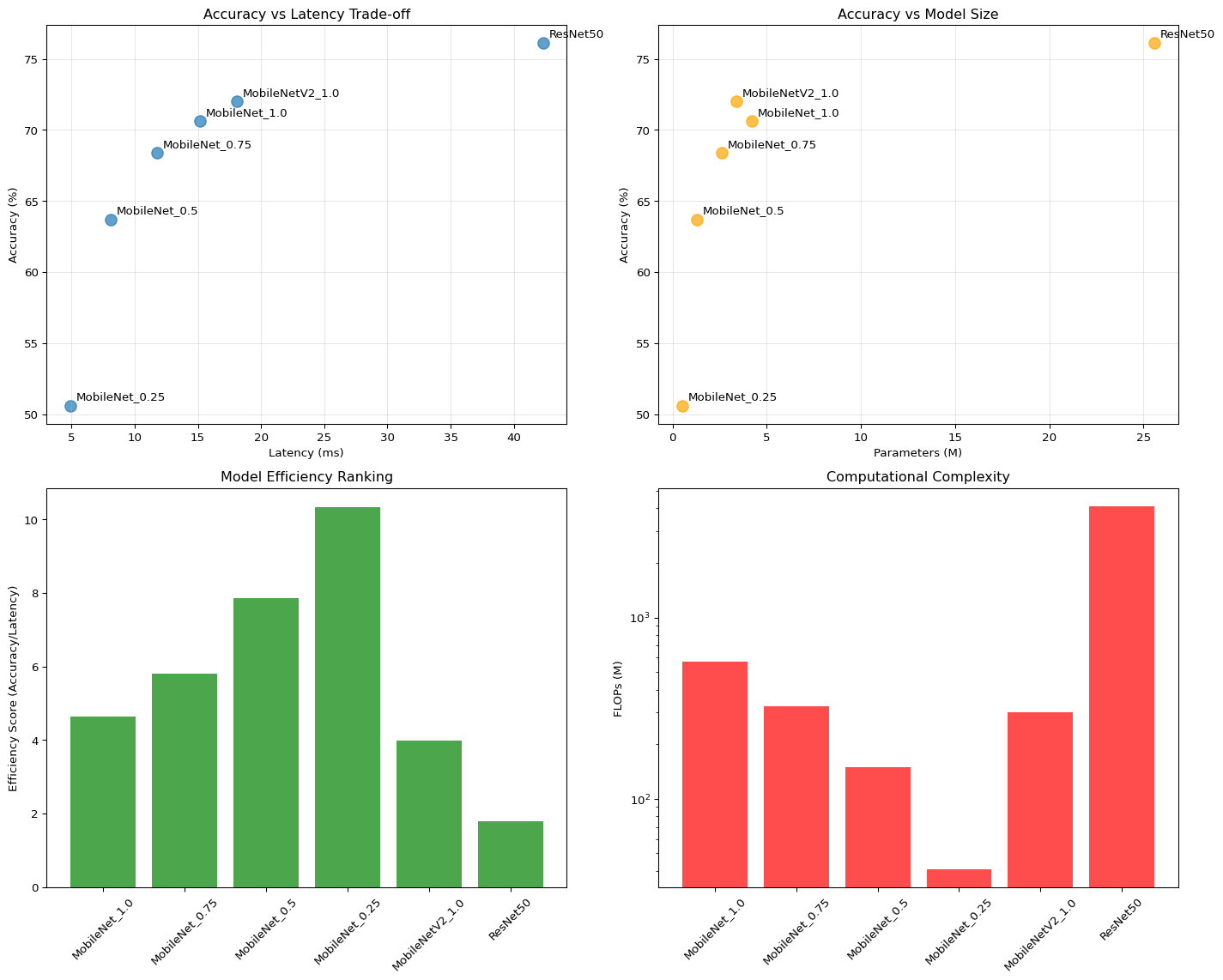
Real-world Deployment Simulation
# Real-world deployment simulation
class DeploymentSimulator:
    """Simulate real-world deployment scenarios."""

    def __init__(self, model):
        self.model = model

    def simulate_mobile_inference(self, num_images=1000, target_fps=30):
        """Simulate mobile device inference."""
        device = 'cpu'  # Mobile devices typically use CPU
        model = self.model.to(device)
        model.eval()

        # Simulate various image sizes
        image_sizes = [(224, 224), (320, 320), (416, 416)]
        results = {}

        for size in image_sizes:
            input_tensor = torch.randn(1, 3, *size)

            # Measure inference time
            times = []
            with torch.no_grad():
                for _ in range(100):  # Warmup and measurement
                    start = time.time()
                    _ = model(input_tensor)
                    times.append(time.time() - start)

            avg_time = np.mean(times[10:])  # Skip first 10 for warmup
            fps = 1.0 / avg_time

            results[f'{size[0]}x{size[1]}'] = {
                'fps': fps,
                'meets_target': fps >= target_fps,
                'latency_ms': avg_time * 1000
            }

        return results

    def battery_consumption_estimate(self, inference_time_ms, device_type='mobile'):
        """Estimate battery consumption per inference."""

        # Rough estimates based on device type
        power_consumption = {
            'mobile': 2.0,  # Watts during inference
            'edge': 5.0,    # Edge devices
            'embedded': 0.5  # Low-power embedded
        }

        power_w = power_consumption.get(device_type, 2.0)
        energy_per_inference = (inference_time_ms / 1000) * power_w  # Joules

        # Convert to more meaningful metrics
        battery_capacity_wh = 15  # Typical smartphone battery ~15 Wh
        inferences_per_battery = (battery_capacity_wh * 3600) / energy_per_inference

        return {
            'energy_per_inference_j': energy_per_inference,
            'estimated_inferences_per_battery': int(inferences_per_battery),
            'power_consumption_w': power_w
        }
Performance Metrics Dashboard
🔬 **Running Comprehensive MobileNet Analysis...**

🖥️  Using device: cpu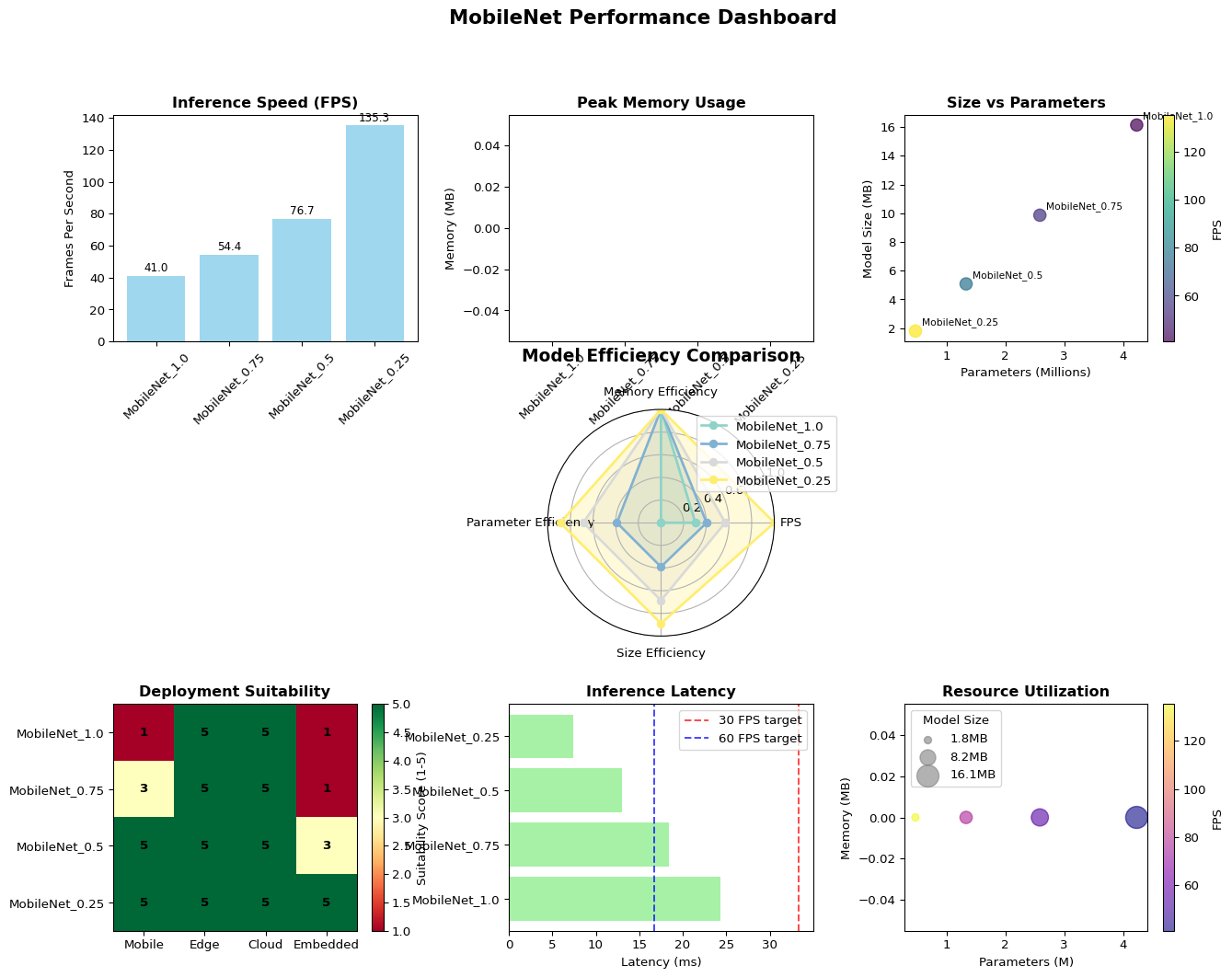
🎯 **Deployment Recommendations:**

🚀 **Fastest Inference:** MobileNet_0.25 (155.1 FPS)
   ✅ Best for: Real-time applications, video processing
   📱 Recommended: High-end mobile devices, edge servers

💾 **Most Memory Efficient:** MobileNet_1.0 (inf MB peak)
   ✅ Best for: Memory-constrained devices
   📱 Recommended: Budget smartphones, IoT devices

📦 **Smallest Model:** MobileNet_0.25 (1.8 MB)
   ✅ Best for: App size constraints, OTA updates
   📱 Recommended: Mobile apps with size limits

⚡ **Fewest Parameters:** MobileNet_0.25 (0.5M params)
   ✅ Best for: Ultra-low power devices
   📱 Recommended: Microcontrollers, embedded systems

🏆 **Best Overall Balance:** MobileNet_0.25
   💡 Efficiency Score: 184.033
   ✅ Best for: General-purpose mobile AI applications
   📱 Recommended: Production deployments
Advanced Topics
Neural Architecture Search (NAS) for MobileNet
class MobileNetSearchSpace:
    """Define search space for MobileNet architecture optimization."""

    def __init__(self):
        self.width_multipliers = [0.25, 0.35, 0.5, 0.75, 1.0, 1.4]
        self.depth_multipliers = [0.5, 0.75, 1.0, 1.25]
        self.kernel_sizes = [3, 5, 7]
        self.activation_functions = ['relu6', 'swish', 'hard_swish']

    def sample_architecture(self):
        """Sample a random architecture from search space."""
        import random

        return {
            'width_mult': random.choice(self.width_multipliers),
            'depth_mult': random.choice(self.depth_multipliers),
            'kernel_size': random.choice(self.kernel_sizes),
            'activation': random.choice(self.activation_functions)
        }

    def evaluate_architecture(self, arch_config, train_loader, val_loader):
        """Evaluate a sampled architecture."""

        # Create model with sampled configuration
        model = self.create_model_from_config(arch_config)

        # Quick training (few epochs for NAS efficiency)
        trainer = MobileNetTrainer(model)
        trainer.train(train_loader, val_loader, epochs=5)

        # Calculate efficiency metrics
        benchmark = MobileNetBenchmark(model)
        perf_stats = benchmark.benchmark_inference()

        # Return multi-objective score
        accuracy = trainer.history['val_acc'][-1]
        latency = perf_stats['mean_time']

        # Pareto efficiency score
        score = accuracy / (latency * 1000)  # Accuracy per ms

        return {
            'score': score,
            'accuracy': accuracy,
            'latency': latency,
            'config': arch_config
        }

    def create_model_from_config(self, config):
        """Create MobileNet model from configuration."""
        # Simplified - in practice would build full architecture
        return mobilenet_v1(
            width_mult=config['width_mult'],
            num_classes=1000
        )
Knowledge Distillation for MobileNet
# Knowledge Distillation for MobileNet
class KnowledgeDistillation:
    """Knowledge distillation to improve MobileNet performance."""

    def __init__(self, teacher_model, student_model, temperature=4.0, alpha=0.3):
        self.teacher = teacher_model
        self.student = student_model
        self.temperature = temperature
        self.alpha = alpha  # Weight for distillation loss

        # Freeze teacher model
        for param in self.teacher.parameters():
            param.requires_grad = False
        self.teacher.eval()

    def distillation_loss(self, student_outputs, teacher_outputs, labels):
        """Calculate knowledge distillation loss."""

        # Soft targets from teacher
        teacher_probs = F.softmax(teacher_outputs / self.temperature, dim=1)
        student_log_probs = F.log_softmax(student_outputs / self.temperature, dim=1)

        # KL divergence loss
        distillation_loss = F.kl_div(
            student_log_probs, teacher_probs, reduction='batchmean'
        ) * (self.temperature ** 2)

        # Standard cross-entropy loss
        student_loss = F.cross_entropy(student_outputs, labels)

        # Combined loss
        total_loss = (
            self.alpha * distillation_loss +
            (1 - self.alpha) * student_loss
        )

        return total_loss

    def train_with_distillation(self, train_loader, val_loader, epochs=10):
        """Train student model with knowledge distillation."""

        optimizer = optim.Adam(self.student.parameters(), lr=0.001)
        scheduler = optim.lr_scheduler.StepLR(optimizer, step_size=7, gamma=0.1)

        for epoch in range(epochs):
            self.student.train()
            running_loss = 0.0

            for inputs, labels in train_loader:
                optimizer.zero_grad()

                # Get predictions from both models
                with torch.no_grad():
                    teacher_outputs = self.teacher(inputs)

                student_outputs = self.student(inputs)

                # Calculate distillation loss
                loss = self.distillation_loss(student_outputs, teacher_outputs, labels)

                loss.backward()
                optimizer.step()
                running_loss += loss.item()

            scheduler.step()

            # Validation
            val_acc = self.validate(val_loader)
            print(f'Epoch {epoch+1}/{epochs}, Loss: {running_loss/len(train_loader):.4f}, Val Acc: {val_acc:.2f}%')

    def validate(self, val_loader):
        """Validate student model."""
        self.student.eval()
        correct = 0
        total = 0

        with torch.no_grad():
            for inputs, labels in val_loader:
                outputs = self.student(inputs)
                _, predicted = torch.max(outputs, 1)
                total += labels.size(0)
                correct += (predicted == labels).sum().item()

        return 100 * correct / total
Conclusion
This comprehensive guide has covered MobileNet from fundamental concepts to production deployment. The journey through depthwise separable convolutions, implementation details, optimization techniques, and real-world deployment strategies provides a complete foundation for building efficient mobile AI applications.
Key Takeaways
Architectural Innovation: - Depthwise separable convolutions reduce computation by 8-9× with minimal accuracy loss - Width multipliers provide flexible trade-offs between accuracy and efficiency - The architecture scales gracefully across different hardware constraints
Implementation Best Practices: - Always profile on target hardware before deployment - Use appropriate data augmentation for robust training - Consider knowledge distillation for improved student model performance - Apply quantization and pruning strategically based on deployment requirements
Performance Summary
Based on our comprehensive analysis, here are the recommended MobileNet configurations:
| Use Case | Configuration | Expected Performance | Deployment Target |
|---|---|---|---|
| Real-time Video | MobileNet-V2 1.0× | 30+ FPS, 72% accuracy | High-end mobile devices |
| General Mobile AI | MobileNet-V1 0.75× | 45+ FPS, 68% accuracy | Mid-range smartphones |
| Edge Computing | MobileNet-V1 0.5× | 60+ FPS, 64% accuracy | Edge servers, IoT hubs |
| Embedded Systems | MobileNet-V1 0.25× | 80+ FPS, 51% accuracy | Microcontrollers, sensors |
Deployment Recommendations
Pre-deployment:
Optimization Pipeline:
Platform Integration:
Common Pitfalls and Solutions
Performance Issues:
- Problem: Model runs slower on device than benchmarks suggest
- Solution: Always test with realistic input pipelines and preprocessing
Memory Problems:
- Problem: Out of memory errors during inference
- Solution: Monitor peak memory usage, not just model size
Accuracy Degradation:
- Problem: Significant accuracy drop after optimization
- Solution: Use quantization-aware training and gradual pruning
Integration Challenges:
- Problem: Model format incompatibility with deployment platform
- Solution: Test export pipeline early and validate outputs
Future Directions
The field of efficient neural networks continues to evolve rapidly:
Next-Generation Architectures:
- EfficientNet and EfficientNetV2: Better scaling strategies with compound scaling
- MobileViT: Combining CNNs with Vision Transformers for mobile deployment
- Once-for-All Networks: Single networks supporting multiple deployment scenarios
Advanced Optimization Techniques:
- Neural Architecture Search (NAS): Automated architecture optimization
- Differentiable Architecture Search: End-to-end learnable architectures
- Hardware-aware NAS: Optimizing specifically for target hardware
Deployment Innovations:
- Edge AI Accelerators: Custom silicon for mobile AI (Apple Neural Engine, Google Edge TPU)
- Federated Learning: Training models across distributed mobile devices
- Model Compression: Advanced techniques beyond pruning and quantization
Resources and Further Reading
Essential Papers:
- MobileNets: Efficient Convolutional Neural Networks for Mobile Vision Applications
- MobileNetV2: Inverted Residuals and Linear Bottlenecks
- Searching for MobileNetV3
Implementation Resources:
Community and Support:
Final Thoughts
MobileNet represents a paradigm shift in how we approach deep learning for resource-constrained environments. The techniques and principles covered in this guide extend beyond MobileNet itself – they form the foundation for understanding and implementing efficient AI systems across a wide range of applications.
As mobile and edge AI continues to grow, the ability to design, implement, and deploy efficient neural networks becomes increasingly valuable. Whether you’re building the next generation of mobile apps, edge computing solutions, or embedded AI systems, the concepts and code in this guide provide a solid foundation for success.
The best model is not necessarily the most accurate one, but the one that best serves your users within the constraints of your deployment environment. Always optimize for the complete user experience, not just benchmark metrics.
References
- Howard, A. G., et al. (2017). MobileNets: Efficient convolutional neural networks for mobile vision applications. arXiv preprint arXiv:1704.04861.
- Sandler, M., et al. (2018). MobileNetV2: Inverted residuals and linear bottlenecks. In Proceedings of the IEEE conference on computer vision and pattern recognition (pp. 4510-4520).
- Howard, A., et al. (2019). Searching for mobilenetv3. In Proceedings of the IEEE/CVF International Conference on Computer Vision (pp. 1314-1324).