Introduction
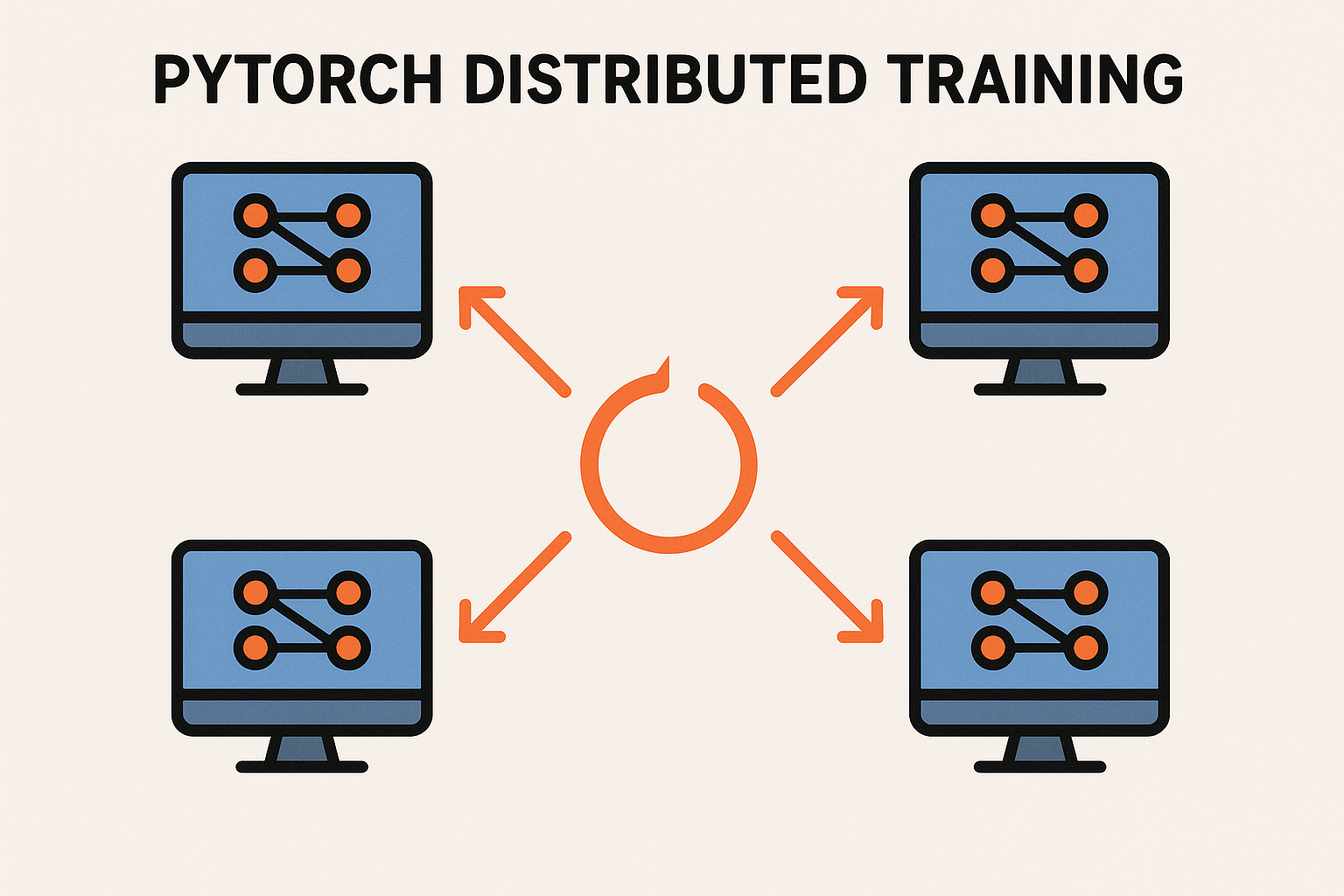
Distributed training allows you to scale PyTorch models across multiple GPUs and machines, dramatically reducing training time for large models and datasets. This guide covers practical implementation patterns from basic data parallelism to advanced distributed strategies.
Core Concepts
Key Terminology
- World Size: Total number of processes participating in training
- Rank: Unique identifier for each process (0 to world_size-1)
- Local Rank: Process identifier within a single node/machine
- Process Group: Collection of processes that can communicate with each other
- Backend: Communication backend (NCCL for GPU, Gloo for CPU)
Communication Patterns
- All-Reduce: Combine values from all processes and distribute the result
- Broadcast: Send data from one process to all others
- Gather: Collect data from all processes to one process
- Scatter: Distribute data from one process to all others
Setup and Initialization
Basic Environment Setup
import os
import torch
import torch.distributed as dist
import torch.multiprocessing as mp
from torch.nn.parallel import DistributedDataParallel as DDP
from torch.utils.data.distributed import DistributedSampler

def setup_distributed(rank, world_size, backend='nccl'):
    """Initialize distributed training environment"""
    os.environ['MASTER_ADDR'] = 'localhost'
    os.environ['MASTER_PORT'] = '12355'

    # Initialize process group
    dist.init_process_group(
        backend=backend,
        rank=rank,
        world_size=world_size
    )

    # Set device for current process
    torch.cuda.set_device(rank)

def cleanup_distributed():
    """Clean up distributed training"""
    dist.destroy_process_group()
Multi-Node Setup
def setup_multinode(rank, world_size, master_addr, master_port):
    """Setup for multi-node distributed training"""
    os.environ['MASTER_ADDR'] = master_addr
    os.environ['MASTER_PORT'] = str(master_port)
    os.environ['RANK'] = str(rank)
    os.environ['WORLD_SIZE'] = str(world_size)

    dist.init_process_group(
        backend='nccl',
        init_method='env://',
        rank=rank,
        world_size=world_size
    )
Data Parallel Training
Simple DataParallel (Single Node)
import torch.nn as nn

class SimpleModel(nn.Module):
    def __init__(self, input_size, hidden_size, num_classes):
        super().__init__()
        self.fc1 = nn.Linear(input_size, hidden_size)
        self.relu = nn.ReLU()
        self.fc2 = nn.Linear(hidden_size, num_classes)

    def forward(self, x):
        x = self.fc1(x)
        x = self.relu(x)
        x = self.fc2(x)
        return x

def train_dataparallel():
    """Basic DataParallel training"""
    device = torch.device("cuda" if torch.cuda.is_available() else "cpu")

    # Create model and wrap with DataParallel
    model = SimpleModel(784, 256, 10)
    if torch.cuda.device_count() > 1:
        model = nn.DataParallel(model)
    model.to(device)

    # Setup optimizer and loss
    optimizer = torch.optim.Adam(model.parameters(), lr=0.001)
    criterion = nn.CrossEntropyLoss()

    # Training loop
    for epoch in range(num_epochs):
        for batch_idx, (data, target) in enumerate(train_loader):
            data, target = data.to(device), target.to(device)

            optimizer.zero_grad()
            output = model(data)
            loss = criterion(output, target)
            loss.backward()
            optimizer.step()
Distributed Data Parallel (DDP)
Basic DDP Implementation
def train_ddp(rank, world_size):
    """Distributed Data Parallel training function"""
    # Setup distributed environment
    setup_distributed(rank, world_size)

    # Create model and move to GPU
    model = SimpleModel(784, 256, 10).to(rank)

    # Wrap model with DDP
    ddp_model = DDP(model, device_ids=[rank])

    # Setup distributed sampler
    train_sampler = DistributedSampler(
        train_dataset,
        num_replicas=world_size,
        rank=rank,
        shuffle=True
    )

    train_loader = torch.utils.data.DataLoader(
        train_dataset,
        batch_size=batch_size,
        sampler=train_sampler,
        num_workers=4,
        pin_memory=True
    )

    # Setup optimizer and loss
    optimizer = torch.optim.Adam(ddp_model.parameters(), lr=0.001)
    criterion = nn.CrossEntropyLoss()

    # Training loop
    for epoch in range(num_epochs):
        train_sampler.set_epoch(epoch)  # Important for shuffling

        for batch_idx, (data, target) in enumerate(train_loader):
            data, target = data.to(rank), target.to(rank)

            optimizer.zero_grad()
            output = ddp_model(data)
            loss = criterion(output, target)
            loss.backward()
            optimizer.step()

            if rank == 0 and batch_idx % 100 == 0:
                print(f'Epoch: {epoch}, Batch: {batch_idx}, Loss: {loss.item():.4f}')

    cleanup_distributed()

def main():
    """Main function to spawn distributed processes"""
    world_size = torch.cuda.device_count()
    mp.spawn(train_ddp, args=(world_size,), nprocs=world_size, join=True)

if __name__ == "__main__":
    main()
Complete Training Script with Validation
import time
from torch.utils.tensorboard import SummaryWriter

class DistributedTrainer:
    def __init__(self, model, rank, world_size, train_loader, val_loader=None):
        self.model = model
        self.rank = rank
        self.world_size = world_size
        self.train_loader = train_loader
        self.val_loader = val_loader

        # Setup DDP
        self.ddp_model = DDP(model, device_ids=[rank])

        # Setup optimizer and scheduler
        self.optimizer = torch.optim.AdamW(
            self.ddp_model.parameters(),
            lr=0.001,
            weight_decay=0.01
        )
        self.scheduler = torch.optim.lr_scheduler.CosineAnnealingLR(
            self.optimizer, T_max=100
        )
        self.criterion = nn.CrossEntropyLoss()

        # Logging (only on rank 0)
        if rank == 0:
            self.writer = SummaryWriter('runs/distributed_training')

    def train_epoch(self, epoch):
        """Train for one epoch"""
        self.ddp_model.train()
        total_loss = 0
        num_batches = 0

        for batch_idx, (data, target) in enumerate(self.train_loader):
            data, target = data.to(self.rank), target.to(self.rank)

            self.optimizer.zero_grad()
            output = self.ddp_model(data)
            loss = self.criterion(output, target)
            loss.backward()

            # Gradient clipping
            torch.nn.utils.clip_grad_norm_(self.ddp_model.parameters(), max_norm=1.0)

            self.optimizer.step()

            total_loss += loss.item()
            num_batches += 1

            if self.rank == 0 and batch_idx % 100 == 0:
                print(f'Epoch: {epoch}, Batch: {batch_idx}, Loss: {loss.item():.4f}')

        avg_loss = total_loss / num_batches
        return avg_loss

    def validate(self):
        """Validate the model"""
        if self.val_loader is None:
            return None

        self.ddp_model.eval()
        total_loss = 0
        correct = 0
        total = 0

        with torch.no_grad():
            for data, target in self.val_loader:
                data, target = data.to(self.rank), target.to(self.rank)
                output = self.ddp_model(data)
                loss = self.criterion(output, target)

                total_loss += loss.item()
                pred = output.argmax(dim=1)
                correct += pred.eq(target).sum().item()
                total += target.size(0)

        # Gather metrics from all processes
        total_loss_tensor = torch.tensor(total_loss).to(self.rank)
        correct_tensor = torch.tensor(correct).to(self.rank)
        total_tensor = torch.tensor(total).to(self.rank)

        dist.all_reduce(total_loss_tensor, op=dist.ReduceOp.SUM)
        dist.all_reduce(correct_tensor, op=dist.ReduceOp.SUM)
        dist.all_reduce(total_tensor, op=dist.ReduceOp.SUM)

        avg_loss = total_loss_tensor.item() / self.world_size
        accuracy = correct_tensor.item() / total_tensor.item()

        return avg_loss, accuracy

    def save_checkpoint(self, epoch, loss):
        """Save model checkpoint (only on rank 0)"""
        if self.rank == 0:
            checkpoint = {
                'epoch': epoch,
                'model_state_dict': self.ddp_model.module.state_dict(),
                'optimizer_state_dict': self.optimizer.state_dict(),
                'scheduler_state_dict': self.scheduler.state_dict(),
                'loss': loss,
            }
            torch.save(checkpoint, f'checkpoint_epoch_{epoch}.pth')

    def train(self, num_epochs):
        """Complete training loop"""
        for epoch in range(num_epochs):
            start_time = time.time()

            # Set epoch for distributed sampler
            if hasattr(self.train_loader.sampler, 'set_epoch'):
                self.train_loader.sampler.set_epoch(epoch)

            # Train
            train_loss = self.train_epoch(epoch)

            # Validate
            val_metrics = self.validate()

            # Step scheduler
            self.scheduler.step()

            # Logging and checkpointing (rank 0 only)
            if self.rank == 0:
                epoch_time = time.time() - start_time
                print(f'Epoch {epoch}: Train Loss: {train_loss:.4f}, '
                      f'Time: {epoch_time:.2f}s')

                if val_metrics:
                    val_loss, val_acc = val_metrics
                    print(f'Val Loss: {val_loss:.4f}, Val Acc: {val_acc:.4f}')

                    # TensorBoard logging
                    self.writer.add_scalar('Loss/Train', train_loss, epoch)
                    self.writer.add_scalar('Loss/Val', val_loss, epoch)
                    self.writer.add_scalar('Accuracy/Val', val_acc, epoch)

                # Save checkpoint
                if epoch % 10 == 0:
                    self.save_checkpoint(epoch, train_loss)
Advanced Patterns
Mixed Precision Training
from torch.cuda.amp import GradScaler, autocast

class MixedPrecisionTrainer(DistributedTrainer):
    def __init__(self, *args, **kwargs):
        super().__init__(*args, **kwargs)
        self.scaler = GradScaler()

    def train_epoch(self, epoch):
        """Train with mixed precision"""
        self.ddp_model.train()
        total_loss = 0
        num_batches = 0

        for batch_idx, (data, target) in enumerate(self.train_loader):
            data, target = data.to(self.rank), target.to(self.rank)

            self.optimizer.zero_grad()

            # Forward pass with autocast
            with autocast():
                output = self.ddp_model(data)
                loss = self.criterion(output, target)

            # Backward pass with scaled gradients
            self.scaler.scale(loss).backward()

            # Gradient clipping with scaled gradients
            self.scaler.unscale_(self.optimizer)
            torch.nn.utils.clip_grad_norm_(self.ddp_model.parameters(), max_norm=1.0)

            # Optimizer step with scaler
            self.scaler.step(self.optimizer)
            self.scaler.update()

            total_loss += loss.item()
            num_batches += 1

        return total_loss / num_batches
Model Sharding with FSDP
from torch.distributed.fsdp import FullyShardedDataParallel as FSDP
from torch.distributed.fsdp.wrap import size_based_auto_wrap_policy

def create_fsdp_model(model, rank):
    """Create FSDP wrapped model"""
    wrap_policy = size_based_auto_wrap_policy(min_num_params=100000)

    fsdp_model = FSDP(
        model,
        auto_wrap_policy=wrap_policy,
        mixed_precision=torch.distributed.fsdp.MixedPrecision(
            param_dtype=torch.float16,
            reduce_dtype=torch.float16,
            buffer_dtype=torch.float16
        ),
        device_id=rank,
        sync_module_states=True,
        sharding_strategy=torch.distributed.fsdp.ShardingStrategy.FULL_SHARD
    )

    return fsdp_model
Pipeline Parallelism
import torch.distributed.pipeline.sync as Pipe

class PipelineModel(nn.Module):
    def __init__(self, layers_per_partition=2):
        super().__init__()

        # Define layers
        layers = []
        layers.append(nn.Linear(784, 512))
        layers.append(nn.ReLU())
        layers.append(nn.Linear(512, 256))
        layers.append(nn.ReLU())
        layers.append(nn.Linear(256, 128))
        layers.append(nn.ReLU())
        layers.append(nn.Linear(128, 10))

        # Create pipeline
        self.pipe = Pipe.Pipe(
            nn.Sequential(*layers),
            balance=[layers_per_partition] * (len(layers) // layers_per_partition),
            devices=[0, 1],  # GPU devices
            chunks=8  # Number of micro-batches
        )

    def forward(self, x):
        return self.pipe(x)
Monitoring and Debugging
Performance Profiling
import torch.profiler

def profile_training(trainer, num_steps=100):
    """Profile distributed training performance"""
    with torch.profiler.profile(
        activities=[
            torch.profiler.ProfilerActivity.CPU,
            torch.profiler.ProfilerActivity.CUDA,
        ],
        schedule=torch.profiler.schedule(wait=1, warmup=1, active=3, repeat=2),
        on_trace_ready=torch.profiler.tensorboard_trace_handler('./log/profiler'),
        record_shapes=True,
        profile_memory=True,
        with_stack=True
    ) as prof:
        for step, (data, target) in enumerate(trainer.train_loader):
            if step >= num_steps:
                break

            data, target = data.to(trainer.rank), target.to(trainer.rank)

            trainer.optimizer.zero_grad()
            output = trainer.ddp_model(data)
            loss = trainer.criterion(output, target)
            loss.backward()
            trainer.optimizer.step()

            prof.step()
Communication Debugging
def debug_communication():
    """Debug distributed communication"""
    rank = dist.get_rank()
    world_size = dist.get_world_size()

    # Test all-reduce
    tensor = torch.randn(10).cuda()
    print(f"Rank {rank}: Before all-reduce: {tensor.sum().item():.4f}")

    dist.all_reduce(tensor, op=dist.ReduceOp.SUM)
    print(f"Rank {rank}: After all-reduce: {tensor.sum().item():.4f}")

    # Test broadcast
    if rank == 0:
        broadcast_tensor = torch.randn(5).cuda()
    else:
        broadcast_tensor = torch.zeros(5).cuda()

    dist.broadcast(broadcast_tensor, src=0)
    print(f"Rank {rank}: Broadcast result: {broadcast_tensor.sum().item():.4f}")
Best Practices
Data Loading Optimization
def create_efficient_dataloader(dataset, batch_size, world_size, rank):
    """Create optimized distributed data loader"""
    sampler = DistributedSampler(
        dataset,
        num_replicas=world_size,
        rank=rank,
        shuffle=True,
        drop_last=True  # Ensures consistent batch sizes
    )

    loader = torch.utils.data.DataLoader(
        dataset,
        batch_size=batch_size,
        sampler=sampler,
        num_workers=4,  # Adjust based on system
        pin_memory=True,
        persistent_workers=True,  # Reuse worker processes
        prefetch_factor=2
    )

    return loader
Gradient Synchronization
def train_with_gradient_accumulation(model, optimizer, criterion, data_loader,
                                   accumulation_steps=4):
    """Training with gradient accumulation"""
    model.train()

    for batch_idx, (data, target) in enumerate(data_loader):
        data, target = data.cuda(), target.cuda()

        # Forward pass
        output = model(data)
        loss = criterion(output, target) / accumulation_steps

        # Backward pass
        loss.backward()

        # Update parameters every accumulation_steps
        if (batch_idx + 1) % accumulation_steps == 0:
            optimizer.step()
            optimizer.zero_grad()
Dynamic Loss Scaling
class DynamicLossScaler:
    def __init__(self, init_scale=2.**16, scale_factor=2., scale_window=2000):
        self.scale = init_scale
        self.scale_factor = scale_factor
        self.scale_window = scale_window
        self.counter = 0

    def update(self, overflow):
        if overflow:
            self.scale /= self.scale_factor
            self.counter = 0
        else:
            self.counter += 1
            if self.counter >= self.scale_window:
                self.scale *= self.scale_factor
                self.counter = 0
Launch Script Example
launch_distributed.sh
#!/bin/bash
# launch_distributed.sh

# Single node, multiple GPUs
python -m torch.distributed.launch \
    --nproc_per_node=4 \
    --nnodes=1 \
    --node_rank=0 \
    --master_addr="localhost" \
    --master_port=12345 \
    train_distributed.py

# Multi-node setup
# Node 0:
python -m torch.distributed.launch \
    --nproc_per_node=4 \
    --nnodes=2 \
    --node_rank=0 \
    --master_addr="192.168.1.100" \
    --master_port=12345 \
    train_distributed.py

# Node 1:
python -m torch.distributed.launch \
    --nproc_per_node=4 \
    --nnodes=2 \
    --node_rank=1 \
    --master_addr="192.168.1.100" \
    --master_port=12345 \
    train_distributed.py
Error Handling and Recovery
def robust_train_loop(trainer, num_epochs, checkpoint_dir):
    """Training loop with error handling and recovery"""
    start_epoch = 0

    # Load checkpoint if exists
    latest_checkpoint = find_latest_checkpoint(checkpoint_dir)
    if latest_checkpoint:
        start_epoch = load_checkpoint(trainer, latest_checkpoint)

    for epoch in range(start_epoch, num_epochs):
        try:
            trainer.train_epoch(epoch)

            # Save checkpoint
            if epoch % 5 == 0:
                save_checkpoint(trainer, epoch, checkpoint_dir)

        except RuntimeError as e:
            if "out of memory" in str(e):
                print(f"OOM error at epoch {epoch}, reducing batch size")
                # Implement batch size reduction logic
                torch.cuda.empty_cache()
                continue
            else:
                raise e
        except Exception as e:
            print(f"Error at epoch {epoch}: {e}")
            # Save emergency checkpoint
            save_checkpoint(trainer, epoch, checkpoint_dir, emergency=True)
            raise e
Conclusion
This guide provides a comprehensive foundation for implementing distributed training with PyTorch. Start with basic DDP for single-node multi-GPU setups, then progress to more advanced techniques like FSDP and pipeline parallelism as your models and datasets grow larger.
TipKey Takeaways
- Start Simple: Begin with DataParallel for single-node setups
- Scale Gradually: Move to DDP for multi-node distributed training
- Monitor Performance: Use profiling tools to identify bottlenecks
- Handle Errors: Implement robust error handling and checkpointing
- Optimize Data Loading: Use efficient data loaders and samplers
NoteAdditional Resources
For more advanced topics and latest updates, refer to: - PyTorch Distributed Documentation - FSDP Tutorial - Pipeline Parallelism Guide