Introduction
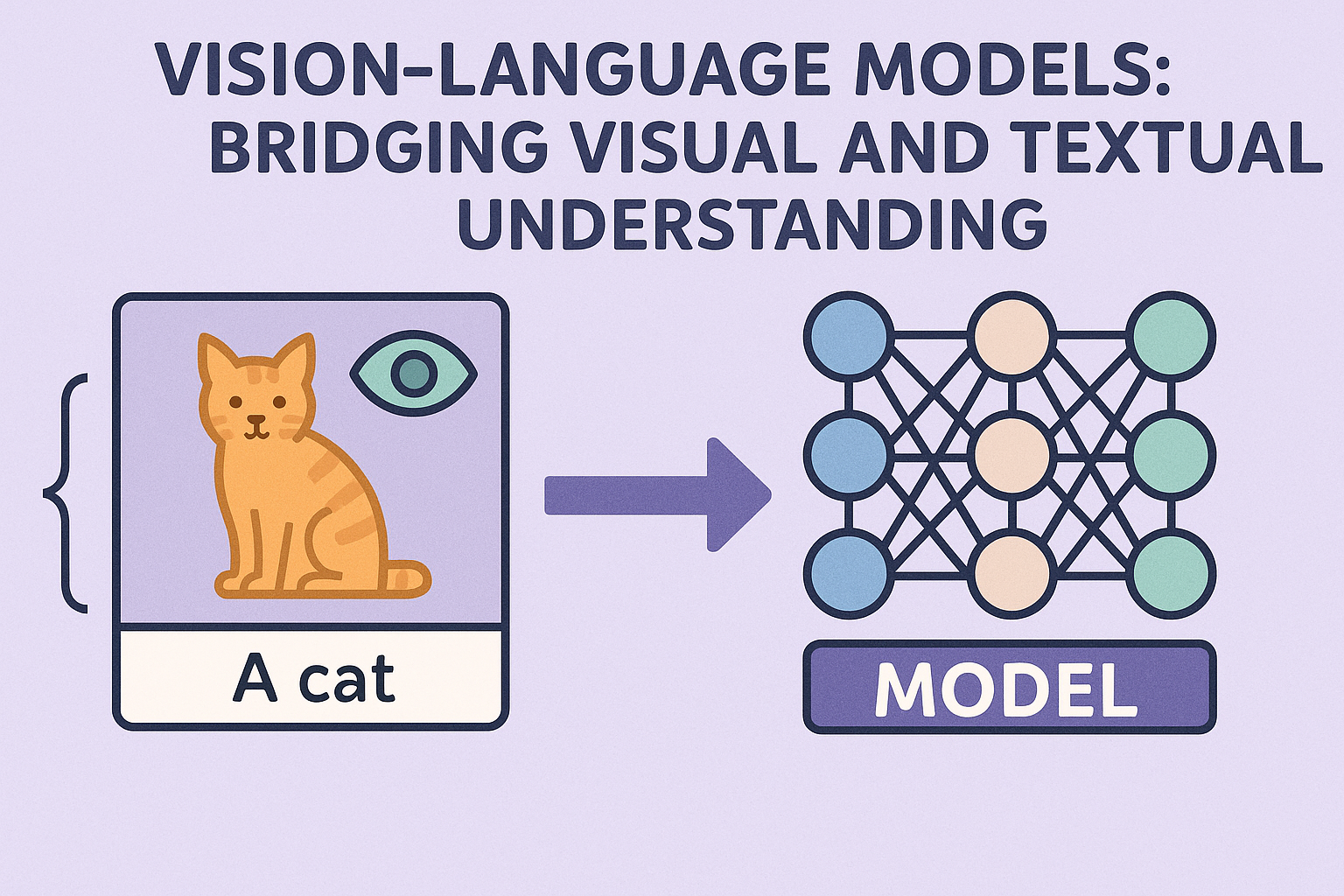
Vision-Language Models (VLMs) represent one of the most exciting frontiers in artificial intelligence, combining computer vision and natural language processing to create systems that can understand and reason about both images and text simultaneously. These multimodal models are revolutionizing how machines interpret the world around us.
What Are Vision-Language Models?
Vision-Language Models are neural networks designed to process and understand both visual and textual information. Unlike traditional models that handle only one modality, VLMs can:
- Describe images in natural language
- Answer questions about visual content
- Generate images from text descriptions
- Perform visual reasoning tasks
- Extract and understand text within images
The key innovation lies in their ability to create shared representations that bridge the semantic gap between visual and linguistic information.
Architecture Deep Dive
Core Components
Most modern VLMs follow a encoder-decoder architecture with several key components:
class VisionLanguageModel:
    def __init__(self):
        self.vision_encoder = VisionTransformer()
        self.text_encoder = TextTransformer()
        self.cross_attention = CrossAttentionLayer()
        self.decoder = LanguageDecoder()

    def forward(self, image, text):
        # Extract visual features
        visual_features = self.vision_encoder(image)

        # Extract textual features
        text_features = self.text_encoder(text)

        # Cross-modal attention
        fused_features = self.cross_attention(
            visual_features, text_features
        )

        # Generate output
        output = self.decoder(fused_features)
        return output
Vision Encoder
The vision component typically uses:
- Vision Transformers (ViTs): Split images into patches and process them as sequences
- Convolutional Neural Networks: Extract hierarchical visual features
- Region-based methods: Focus on specific image regions
def patch_embedding(image, patch_size=16):
    """Convert image to patch embeddings"""
    patches = image.unfold(2, patch_size, patch_size)
    patches = patches.unfold(3, patch_size, patch_size)

    # Flatten patches and create embeddings
    patch_embeddings = patches.reshape(-1, patch_size * patch_size * 3)
    return patch_embeddings
Text Encoder
Text processing leverages transformer architectures:
- BERT-style encoders: For understanding input text
- GPT-style decoders: For generating responses
- Tokenization: Converting text to numerical representations
Cross-Modal Fusion
The critical challenge is combining visual and textual information:
import torch.nn as nn

class CrossAttention(nn.Module):
    def __init__(self, dim):
        super().__init__()
        self.attention = nn.MultiheadAttention(dim, num_heads=8)

    def forward(self, visual_features, text_features):
        # Use text as query, vision as key and value
        attended_features, _ = self.attention(
            query=text_features,
            key=visual_features,
            value=visual_features
        )
        return attended_features
Training Strategies
Contrastive Learning
Many VLMs use contrastive learning to align visual and textual representations:
import torch
import torch.nn.functional as F

def contrastive_loss(image_features, text_features, temperature=0.07):
    """CLIP-style contrastive loss"""
    # Normalize features
    image_features = F.normalize(image_features, dim=-1)
    text_features = F.normalize(text_features, dim=-1)

    # Compute similarity matrix
    similarity = torch.matmul(image_features, text_features.T) / temperature

    # Create labels (diagonal should be positive pairs)
    labels = torch.arange(len(image_features))

    # Compute loss
    loss_i2t = F.cross_entropy(similarity, labels)
    loss_t2i = F.cross_entropy(similarity.T, labels)

    return (loss_i2t + loss_t2i) / 2
Multi-Task Learning
VLMs often train on multiple objectives simultaneously:
- Image-text matching
- Masked language modeling
- Image captioning
- Visual question answering
Data Requirements
Training requires massive paired datasets:
from torch.utils.data import Dataset
from torchvision import transforms
from PIL import Image

class VLMDataset(Dataset):
    def __init__(self, image_paths, captions):
        self.image_paths = image_paths
        self.captions = captions
        self.transform = transforms.Compose([
            transforms.Resize((224, 224)),
            transforms.ToTensor(),
            transforms.Normalize(mean=[0.485, 0.456, 0.406],
                               std=[0.229, 0.224, 0.225])
        ])

    def __getitem__(self, idx):
        image = Image.open(self.image_paths[idx])
        image = self.transform(image)
        caption = self.captions[idx]

        return {
            'image': image,
            'caption': caption,
            'image_id': idx
        }

    def __len__(self):
        return len(self.image_paths)
Popular VLM Architectures
CLIP (Contrastive Language-Image Pre-training)
CLIP learns visual concepts from natural language supervision:
import numpy as np

class CLIP(nn.Module):
    def __init__(self, vision_model, text_model):
        super().__init__()
        self.vision_model = vision_model
        self.text_model = text_model
        self.logit_scale = nn.Parameter(torch.ones([]) * np.log(1/0.07))

    def forward(self, image, text):
        image_features = self.vision_model(image)
        text_features = self.text_model(text)

        # Normalize features
        image_features = image_features / image_features.norm(dim=-1, keepdim=True)
        text_features = text_features / text_features.norm(dim=-1, keepdim=True)

        # Compute similarities
        logit_scale = self.logit_scale.exp()
        logits_per_image = logit_scale * image_features @ text_features.t()

        return logits_per_image
BLIP (Bootstrapping Language-Image Pre-training)
BLIP uses a unified architecture for multiple vision-language tasks:
- Encoder for understanding
- Encoder-decoder for generation
- Decoder for language modeling
Flamingo
Flamingo excels at few-shot learning by conditioning on visual examples:
class FeedForward(nn.Module):
    def __init__(self, dim, hidden_dim=None):
        super().__init__()
        hidden_dim = hidden_dim or 4 * dim
        self.net = nn.Sequential(
            nn.Linear(dim, hidden_dim),
            nn.GELU(),
            nn.Linear(hidden_dim, dim)
        )

    def forward(self, x):
        return self.net(x)

class FlamingoLayer(nn.Module):
    def __init__(self, dim):
        super().__init__()
        self.cross_attention = CrossAttention(dim)
        self.feed_forward = FeedForward(dim)

    def forward(self, text_features, visual_features):
        # Cross-attention between text and vision
        attended = self.cross_attention(text_features, visual_features)

        # Add residual connection
        text_features = text_features + attended

        # Feed forward
        output = self.feed_forward(text_features)

        return output
Implementation Example
Here’s a simplified VLM implementation for image captioning:
import torch
import torch.nn as nn
from transformers import GPT2LMHeadModel, GPT2Tokenizer
from torchvision.models import resnet50

class SimpleVLM(nn.Module):
    def __init__(self, vocab_size=50257, hidden_dim=768):
        super().__init__()

        # Vision encoder
        self.vision_encoder = resnet50(pretrained=True)
        self.vision_encoder.fc = nn.Linear(2048, hidden_dim)

        # Language model
        self.language_model = GPT2LMHeadModel.from_pretrained('gpt2')

        # Projection layer
        self.visual_projection = nn.Linear(hidden_dim, hidden_dim)

    def forward(self, images, input_ids, attention_mask=None):
        # Extract visual features
        visual_features = self.vision_encoder(images)
        visual_features = self.visual_projection(visual_features)

        # Add visual features as prefix to text
        batch_size = visual_features.size(0)
        visual_tokens = visual_features.unsqueeze(1)  # [B, 1, H]

        # Get text embeddings
        text_embeddings = self.language_model.transformer.wte(input_ids)

        # Concatenate visual and text embeddings
        combined_embeddings = torch.cat([visual_tokens, text_embeddings], dim=1)

        # Generate text
        outputs = self.language_model(
            inputs_embeds=combined_embeddings,
            attention_mask=attention_mask
        )

        return outputs
Training Loop
def train_vlm(model, dataloader, optimizer, device):
    """Training loop for VLM"""
    model.train()
    total_loss = 0

    for batch in dataloader:
        images = batch['images'].to(device)
        captions = batch['captions'].to(device)

        # Forward pass
        outputs = model(images, captions[:, :-1])

        # Compute loss
        loss = nn.CrossEntropyLoss()(
            outputs.logits.reshape(-1, outputs.logits.size(-1)),
            captions[:, 1:].reshape(-1)
        )

        # Backward pass
        optimizer.zero_grad()
        loss.backward()
        optimizer.step()

        total_loss += loss.item()

    return total_loss / len(dataloader)
Evaluation Metrics
VLMs are evaluated using various metrics depending on the task:
Image Captioning Metrics
| Metric | Description | Range |
|---|---|---|
| BLEU | N-gram overlap with reference captions | 0-1 |
| ROUGE | Recall-oriented similarity | 0-1 |
| CIDEr | Consensus-based metric for image description | 0-10 |
| SPICE | Semantic similarity metric | 0-1 |
def compute_bleu_score(predictions, references):
    """Compute BLEU score for image captioning"""
    from nltk.translate.bleu_score import corpus_bleu

    # Tokenize predictions and references
    pred_tokens = [pred.split() for pred in predictions]
    ref_tokens = [[ref.split() for ref in refs] for refs in references]

    # Compute BLEU score
    bleu_score = corpus_bleu(ref_tokens, pred_tokens)
    return bleu_score
Visual Question Answering
- Accuracy: Exact match with ground truth answers
- F1 Score: Harmonic mean of precision and recall
Image-Text Retrieval
- Recall@K: Fraction of queries where correct answer is in top-K results
- Mean Reciprocal Rank: Average of reciprocal ranks of correct answers
Applications and Use Cases
Content Generation
def generate_caption(model, image, tokenizer, max_length=50):
    """Generate caption for an image"""
    model.eval()
    with torch.no_grad():
        # Process image
        image_tensor = preprocess_image(image)

        # Generate caption
        generated_ids = model.generate(
            image_tensor,
            max_length=max_length,
            num_beams=5,
            temperature=0.8
        )

        # Decode caption
        caption = tokenizer.decode(generated_ids[0], skip_special_tokens=True)
        return caption

def preprocess_image(image):
    """Preprocess image for model input"""
    transform = transforms.Compose([
        transforms.Resize((224, 224)),
        transforms.ToTensor(),
        transforms.Normalize(mean=[0.485, 0.456, 0.406],
                           std=[0.229, 0.224, 0.225])
    ])
    return transform(image).unsqueeze(0)
Document Understanding
VLMs excel at processing documents with both text and visual elements:
- Form understanding
- Chart and graph interpretation
- Layout analysis
- OCR with context
Other Applications
- Accessibility: Image description for visually impaired users
- E-commerce: Product description generation and visual search
- Navigation: Scene understanding and object recognition
Challenges and Limitations
Computational Requirements
VLMs require significant computational resources:
def estimate_memory_usage(batch_size, image_size, model_params):
    """Estimate GPU memory usage for VLM"""
    image_memory = batch_size * 3 * image_size * image_size * 4  # bytes
    model_memory = model_params * 4  # 4 bytes per parameter
    activation_memory = batch_size * model_params * 0.3  # rough estimate

    total_gb = (image_memory + model_memory + activation_memory) / (1024**3)
    return total_gb

# Example usage
memory_gb = estimate_memory_usage(
    batch_size=32,
    image_size=224,
    model_params=175_000_000  # 175M parameters
)
print(f"Estimated memory usage: {memory_gb:.2f} GB")
Bias and Fairness
VLMs can perpetuate biases present in training data:
- Gender and racial stereotypes
- Cultural biases in image interpretation
- Socioeconomic biases in scene understanding
Hallucination Detection
Models may generate plausible but incorrect descriptions:
def detect_hallucination(caption, image_objects):
    """Simple hallucination detection"""
    mentioned_objects = extract_objects_from_caption(caption)

    hallucinated_objects = []
    for obj in mentioned_objects:
        if obj not in image_objects:
            hallucinated_objects.append(obj)

    return hallucinated_objects

def extract_objects_from_caption(caption):
    """Extract mentioned objects from caption"""
    # Simplified implementation - in practice, use NLP techniques
    import re
    nouns = re.findall(r'\b[a-z]+\b', caption.lower())
    return nouns
Future Directions
Advanced Capabilities
Future VLMs are moving toward more sophisticated reasoning:
- Temporal understanding in videos
- Spatial reasoning in 3D scenes
- Causal reasoning from visual evidence
Efficiency Improvements
Research focuses on making VLMs more efficient:
- Model compression and pruning
- Knowledge distillation
- Efficient attention mechanisms
Interactive Systems
Future VLMs will support more interactive applications:
- Conversational visual AI
- Real-time visual assistance
- Collaborative human-AI systems
Best Practices for Implementation
Data Preparation
import json
import os

def prepare_vlm_dataset(image_dir, caption_file):
    """Prepare dataset for VLM training"""
    dataset = []

    with open(caption_file, 'r') as f:
        for line in f:
            data = json.loads(line)
            image_path = os.path.join(image_dir, data['image'])

            # Quality checks
            if os.path.exists(image_path) and len(data['caption']) > 10:
                dataset.append({
                    'image_path': image_path,
                    'caption': data['caption'],
                    'metadata': data.get('metadata', {})
                })

    return dataset
Model Optimization Tips
- Use mixed precision training
- Implement gradient checkpointing
- Apply learning rate scheduling
- Monitor for overfitting
Deployment Considerations
- Model quantization for edge deployment
- Caching strategies for repeated queries
- Load balancing for high-traffic applications
Conclusion
Vision-Language Models represent a paradigm shift toward more human-like AI systems that can understand and reason about the visual world through natural language. As these models continue to evolve, they promise to unlock new possibilities in human-computer interaction, accessibility, content creation, and automated understanding of our increasingly visual digital world.
The field continues to advance rapidly, with ongoing research addressing current limitations while pushing the boundaries of what’s possible when machines can truly see and understand the world around them. For developers and researchers, VLMs offer exciting opportunities to build applications that bridge the gap between human perception and machine understanding.